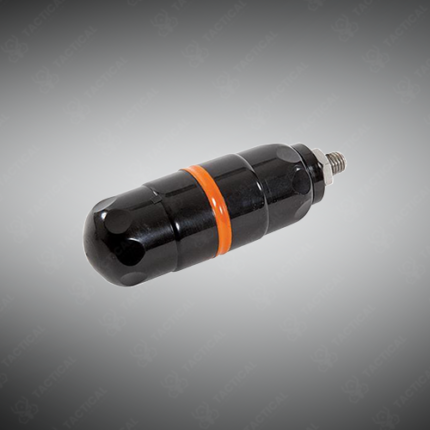
Sonde
Sondes are battery-powered signal transmitters inserted into buried pipes, drain lines, conduit runs, and boreholes to enable surface detection of the underground route using a compatible locator receiver above ground. Standard electromagnetic pipe locators cannot detect non-metallic pipes because these materials carry no conductor for signal induction. A sonde solves this by becoming the signal source inside the pipe itself, allowing the surface operator to track its position as it travels through or sits at a fixed depth within the buried structure.
Sonde transmitters operate at standard locating frequencies including 512 Hz, 8 kHz, 33 kHz, and 640 Hz depending on the application and compatible receiver equipment at the site. The 512 Hz frequency suits most drain and service pipe tracing applications and matches the sonde tracking mode on the majority of current electromagnetic locator receiver models. Sonde body construction uses sealed waterproof polymer or stainless steel housing rated for submersion in water-filled pipes and sewers. Outer diameters run from 16mm on mini sonde variants for small-bore access up to 65mm on large-bore drain inspection sondes. Additionally, battery type uses alkaline cells with operating duration between 8 and 40 hours depending on sonde size and battery capacity, providing sufficient runtime for complete drain survey sessions without battery replacement mid-task.
Push rod sondes attach to standard drain rod sections through a threaded or friction-fit end coupling, allowing the survey crew to drive the sonde through the pipe bore from an access chamber. Freely flowing sondes travel through the pipe under gravity or water flow. Operator depth reading accuracy runs within plus or minus 5% of actual burial depth on compatible locator receivers. Furthermore, detection depth above ground reaches between 3 and 8 meters depending on sonde transmitter power, receiver sensitivity, and soil conductivity conditions at the survey site.
Signal output remains consistent through plastic, clay, concrete, and bitumen pipe materials. Soil conductivity and moisture content affect attenuation. Moreover, most sonde models ship with a spare battery set, a carry pouch, and connection adapters for push rod and drain rod attachment, simplifying field kit preparation before deployment to survey sites across Pakistan’s drainage and utility infrastructure.
Tactical Supply Pakistan supplies sondes to drainage survey contractors, municipal sewerage inspection teams, civil engineering firms, and utility maintenance operators requiring non-metallic pipe and underground structure location capability across drain survey and utility mapping applications throughout Pakistan.
Showing the single result