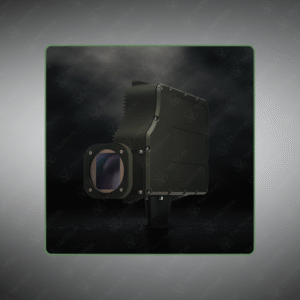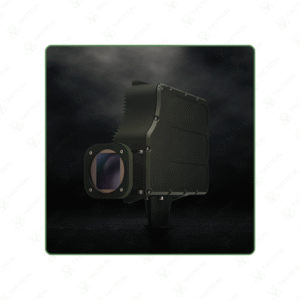
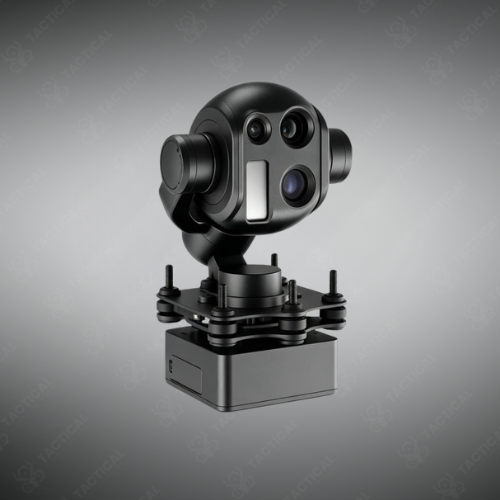
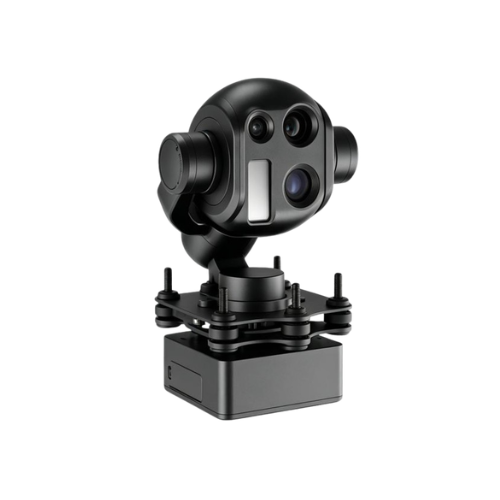
Laser Ranging (LiDAR) Electro-Optical Tracking Gimbal Camera
Multi-sensor EO/IR tracking gimbal integrating daylight imaging, thermal observation, and laser ranging for precision target tracking and localization.
Key Features:
✔️ Full HD daylight camera with up to 30× optical zoom
✔️ Uncooled 640 × 512 thermal sensor operating in the 8–14 µm band
✔️ Integrated laser rangefinder with up to 5 km ranging capability
✔️ Provides range measurements with 1-meter accuracy
✔️ Continuous 360° azimuth rotation for unrestricted target tracking
✔️ Pitch movement range from −45° to +135°
✔️ Stabilization accuracy of ±0.01° to ±0.02° for steady target lock
✔️ Co-boresighted EO, IR, and laser sensors for synchronized tracking
✔️ Supports Ethernet, HDMI, and serial communication interfaces
✔️ Onboard processing enables auto-track and target geo-location
Laser Ranging (LiDAR) Electro-Optical Tracking Gimbal Camera
The Laser Ranging (LiDAR) Electro-Optical Tracking Gimbal Camera houses three co-boresighted sensors inside a two-axis stabilized pan-tilt assembly. Specifically, these include a Full HD daylight camera with up to 30× optical zoom, an uncooled long-wave infrared module (8–14 µm) with 640×512 resolution, and a time-of-flight laser rangefinder reaching up to 5 km with 1-meter measurement accuracy. The gimbal provides continuous 360° azimuth rotation and a pitch range of −45° to +135°. Furthermore, stabilization accuracy holds at ±0.01°–±0.02°, maintaining target lock against low-RCS, fast-moving UAVs. Output interfaces include Ethernet, HDMI, and serial control protocols. Additionally, the EO/IR tracking turret configuration sits on a fixed-mount pedestal for perimeter deployment.
The laser ranging module operates on the TOF (time-of-flight) principle, emitting laser pulses and measuring round-trip propagation time to derive slant range. In addition, combined with encoded gimbal azimuth and elevation angles, the system resolves a full spherical-coordinate fix into Cartesian 3D position data. As a result, onboard processing handles geo-location, auto-track, and live IP-streamed video simultaneously. Moreover, the C-UAS optical tracker function accepts radar cue data via C2 interface and slews the turret autonomously to the designated bearing.
In deployment, the Laser Ranging (LiDAR) Electro-Optical Tracking Gimbal Camera handles the confirm-and-range stage of the engagement chain. After mmWave radar detects a target, this unit slews to the cue and visually confirms the threat across day, low-light, and thermally obscured conditions. It then delivers metric-grade range data that passive optics alone cannot produce. Consequently, fixed-site operators at airports, military installations, power plants, and secured perimeters use it to sustain target track through handoff to downstream effectors.
Tactical Supply Pakistan gives defense integrators and security operators direct access to verified, field-grade counter-UAS hardware. It serves as a single trusted source for layered aerial threat solutions across Pakistan.
What is the difference between EO and IR channels in a tracking gimbal?
The EO (electro-optical) channel captures visible-spectrum daylight imagery for clear color identification. In contrast, the IR (infrared) channel detects heat signatures and operates in total darkness or obscured conditions where EO loses the target. Both channels, however, run simultaneously in a fused display.
- Fast Shipping: We partner with reliable delivery services to make sure your order gets to you quickly. We work hard to ensure every package arrives safely and on time.
- Quick Processing: Your order is processed and prepared for shipping within 24 to 48 hours. This allows us to send it out to you as fast as possible after your payment is confirmed.
- Tracking: Once your order is on its way, we will provide you with a tracking number. You can use this number to easily follow your package's journey and know exactly when it will arrive.
- Nationwide Delivery: We offer delivery to all locations across Pakistan, including major cities and remote areas. No matter where you are, we can get your order to you.
At Tactical Supply Pakistan, our relationship with you doesn't end after a sale. We are dedicated to making the long-term performance and reliability of our high-quality tactical and supplied equipment. Our commitment is to provide you with seamless support and peace of mind.
- Free Installation: We'll set up your new equipment for you, so it's ready to go. You can focus on your work while our engineers handle as per the guidelines for manufacturer.
- Maintenance: We offer quick replacements where necessary, to keep your gear in top condition. Our team will make sure your equipment is always ready when you need it.
- Customer Support: We're always here to help. Our support team is available to answer your questions and assist you long after you've made a purchase.
- Planned Preventative Maintenance: Our service includes preventative maintenance to keep your equipment in peak condition and prevent future issues.
HAVE QUESTIONS?
Fill out the form, and our team will respond promptly to assist with your product inquiries or order support.