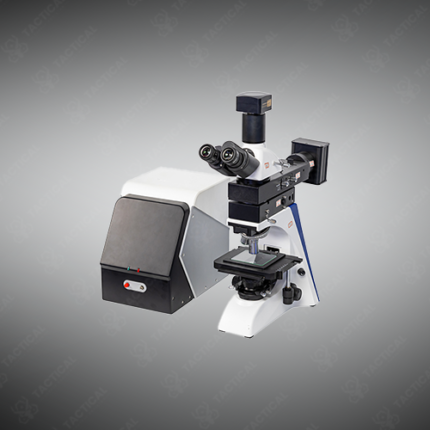
Raman Spectrometer For Chemical Research
Raman spectrometers for chemical research deliver high-resolution molecular spectral data for compound characterization, reaction monitoring, structural analysis, and material science investigations at research institutions, university chemistry departments, and industrial R&D laboratories. These instruments provide more detailed spectral information than portable field units through larger detector arrays, finer spectral resolution, and access to multiple excitation wavelengths within a single platform, supporting complex research applications that require spectral discrimination between closely related chemical structures.
The spectrometer core uses a high-groove-density diffraction grating, typically between 1200 and 1800 lines per millimeter, dispersing the Raman scatter across a back-thinned CCD detector array with pixel counts between 1024 and 2048 across the spectral axis. Spectral resolution on research-grade instruments runs between 0.5 and 2 wavenumbers per centimeter, compared to 8 to 15 wavenumbers on portable field units, enabling confident identification of compound polymorphs, isotopic substitutions, and closely spaced vibrational modes that overlap and remain unresolved on lower-resolution platforms. Additionally, thermoelectric cooling of the CCD detector reduces dark current noise to below 0.001 electrons per pixel per second, significantly improving signal-to-noise ratio during long integration time measurements of weakly scattering samples.
Excitation laser options on research Raman platforms typically include 532nm, 633nm, 785nm, and 1064nm wavelengths accessible through a selectable laser port, allowing the researcher to choose the excitation wavelength that minimizes fluorescence while maximizing signal intensity for each specific sample type. Surface-enhanced Raman spectroscopy capability on some research platforms amplifies signal from trace analytes adsorbed onto noble metal nanoparticle substrates, extending detection sensitivity to single-molecule levels for advanced trace analysis work. Furthermore, confocal microscope coupling with high numerical aperture objectives provides spatially resolved spectra from sample volumes below 1 cubic micrometer, enabling chemical mapping of pharmaceutical crystal cross-sections, polymer blend morphology, and materials interface chemistry at sub-cellular spatial resolution.
Automated sample stage movement with step sizes below 0.1 micrometers supports large-area chemical mapping acquisitions covering sample areas up to 100 x 100 millimeters at user-defined spatial resolution. Moreover, chemometric data processing software handles principal component analysis, hierarchical cluster analysis, and multivariate curve resolution of hyperspectral Raman image datasets, extracting chemical component distribution maps from complex multi-component sample systems.
Tactical Supply Pakistan supplies Raman spectrometers for chemical research to university chemistry and materials science departments, pharmaceutical R&D laboratories, polymer research centers, and defense materials research programs requiring high-resolution molecular characterization capability across advanced analytical chemistry applications throughout Pakistan.
Showing the single result