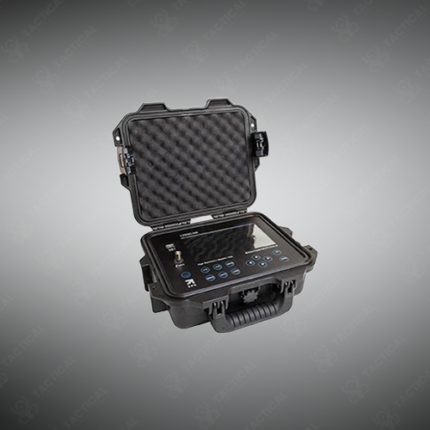
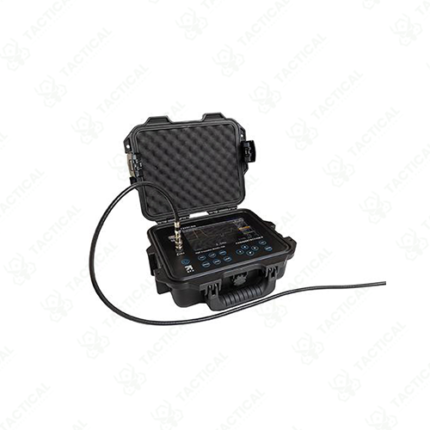
Metallic TDR System
Metallic time domain reflectometry (TDR) systems locate faults on copper cable pairs — including open circuits, short circuits, bridged taps, moisture ingress, and impedance discontinuities — by sending a precisely timed electrical pulse down the cable and measuring the time elapsed before the reflected echo returns from the fault point. These instruments give telecommunications engineers, network maintenance teams, and cable fault locators an accurate, non-destructive method of pinpointing cable faults without excavating the entire cable route.
The measurement principle exploits the fact that any impedance discontinuity on a transmission line — whether a cable cut, a wet splice, a corroded joint, or a load coil — reflects a portion of the incident pulse back toward the source. The TDR measures the round-trip travel time of the reflected pulse and converts it to distance using the cable’s known velocity of propagation (VOP). VOP values for common cable types range from 0.60 to 0.95 times the speed of light — operators enter the correct VOP for the cable under test to obtain accurate fault distance readings. Furthermore, the polarity and amplitude of the reflected pulse indicate fault type. An open circuit reflects a positive-polarity pulse. A short circuit reflects a negative-polarity pulse. Bridged taps and moisture ingress produce characteristic partial-reflection patterns recognizable by experienced operators.
Professional TDR systems such as the Riser Bond 1205CX and Greenlee 920 cover cable lengths from 1 meter to over 50 kilometers — addressing both short building cable runs and long outside plant feeder cable networks. Fault location accuracy reaches ±0.1% of cable length on calibrated systems. Additionally, waveform storage and comparison functions allow operators to capture a baseline waveform on a healthy cable and compare subsequent measurements against it — identifying subtle developing faults before they cause service failures. Dual-port testing enables simultaneous measurement of both conductors in a pair from a single connection point.
These systems serve Pakistan Telecommunication Company (PTCL) outside plant maintenance teams, fiber optic network contractors locating copper feeder faults, ISP network operations centers in Lahore, Karachi, and Islamabad, Pakistan Army signal corps cable maintenance units, and industrial plant telecommunications maintenance departments requiring accurate, rapid copper cable fault location without excavation.
Tactical Supply Pakistan supplies metallic TDR systems for copper cable fault location, outside plant maintenance, and telecommunications network testing procurement across Pakistan.
Showing the single result