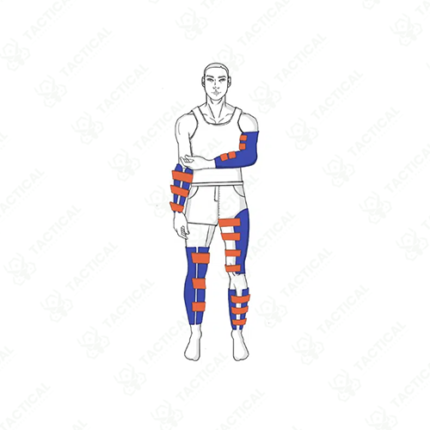
Fracture Splint
A Fracture Splint is a medical immobilization device applied externally to an injured limb to stabilize a suspected or confirmed fracture, preventing further bone displacement, soft tissue damage, and pain during patient movement, extraction, and transport to a definitive medical facility. Unlike a cast applied after clinical assessment, a fracture splint is designed for rapid field or emergency application before imaging confirmation, providing effective temporary immobilization with a design that accommodates limb swelling without requiring removal and reapplication.
Splint materials fall into three primary categories. Aluminum core splints — including the widely used SAM splint — consist of a soft aluminum sheet sandwiched between two layers of closed-cell polyethylene foam, available in lengths from 11cm wrist splints to 91cm full-leg variants. The aluminum core is malleable at room temperature, allowing the responder to shape the splint to the injured limb’s contour or pre-form it into structural configurations — C-curve, T-curve, or reverse-C — that add rigidity without casting plaster or water activation. Thermoplastic splinting materials are heated to 60°C to 80°C in hot water before application, becoming moldable around the limb and hardening to a rigid support structure as they cool to body temperature. Vacuum splints use an airtight envelope filled with polystyrene beads — when air is evacuated through a valve, the beads compact into a rigid mass conforming exactly to the limb geometry, providing custom immobilization for complex fracture presentations including ankle, wrist, and mid-shaft femur injuries.
Padding materials including stockinette, cotton wool, and open-cell foam underlie the splint surface at bony prominences — medial and lateral malleoli, fibular head, and calcaneus — preventing pressure sores during extended immobilization periods. Elastic bandages or hook-and-loop straps secure the splint assembly against the limb without circumferential casting pressure that would compromise distal circulation.
In Pakistan, fracture splints are used by emergency medical technicians, military field medics, police first aid teams, industrial workplace first responders, and school and institutional medical rooms for acute fracture management before hospital transfer.
Tactical Supply Pakistan supplies fracture splints across aluminum, thermoplastic, and vacuum configurations for emergency medical, military, and institutional first aid procurement across Pakistan.
Showing the single result