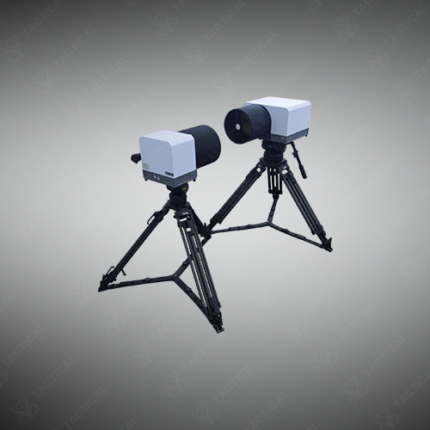
Fourier Transform Spectroscopy (FTS)
Fourier Transform Spectroscopy (FTS) is a measurement technique that determines the spectral composition of radiation — infrared, near-infrared, visible, or ultraviolet — by analyzing the interference pattern produced when a beam of broadband radiation is split into two paths of varying optical path difference and then recombined, rather than dispersing radiation through a prism or diffraction grating as in conventional dispersive spectrometers. The resulting interferogram contains encoded intensity information from all wavelengths simultaneously, which a fast Fourier transform (FFT) algorithm decodes into a conventional spectrum of intensity versus wavelength or wavenumber.
The core optical component is a Michelson interferometer incorporating a beam splitter — material selected by the spectral range of interest: KBr for mid-infrared, CaF₂ for near-infrared, and quartz for visible and UV — a fixed mirror, and a scanning mirror driven by a precision actuator. As the moving mirror displaces from the zero path difference position, each wavelength in the source radiation produces a sinusoidal oscillation in the combined beam intensity at a frequency proportional to the mirror velocity and the wavenumber of the radiation, with all wavelength oscillations superimposed in the recorded interferogram signal.
The Fellgett (multiplex) advantage gives FTS instruments inherently better signal-to-noise ratios than sequential scanning instruments at equal measurement times, as all spectral elements are measured simultaneously throughout each scan. The Jacquinot (throughput) advantage provides higher optical throughput compared to grating spectrometers with equivalent resolution, since FTS instruments use circular apertures rather than entrance slits to define beam geometry.
Spectral resolution in FTS systems is determined by the maximum optical path difference achieved by the scanning mirror — resolution in cm⁻¹ equals the reciprocal of twice the maximum mirror displacement in centimeters — with high-resolution astronomical and atmospheric FTS instruments achieving resolutions below 0.001 cm⁻¹ through mirror travel exceeding 50 centimeters.
In Pakistan, Fourier Transform Spectroscopy instruments are used in university physics and chemistry departments, pharmaceutical analytical laboratories, atmospheric science research programs, semiconductor material characterization facilities, and defense research institutions requiring high-resolution spectral measurement capability.
Tactical Supply Pakistan supplies Fourier Transform Spectroscopy instruments across infrared, near-infrared, and visible spectral range configurations for research, analytical, and defense procurement across Pakistan.
Showing the single result