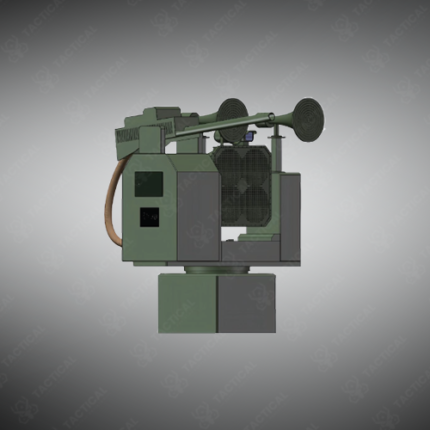
Advanced Vehicle C-UAS Detection and Jamming system
An advanced vehicle-mounted counter-UAS detection and jamming system provides mobile protection against drone threats by combining passive RF detection, radar or electro-optical tracking, and active jamming into a single platform installed on a tactical or armoured vehicle. The mobile configuration allows the protection envelope to travel with a convoy, VIP motorcade, or patrol element rather than being fixed to a single defended point — a critical capability when threat vectors are unpredictable across extended routes.
The detection layer typically incorporates a wideband RF scanner covering 400MHz to 6GHz to identify drone control links and video downlinks, a small-aperture pulse-Doppler or FMCW radar for kinematic target detection regardless of RF emissions, and an electro-optical and thermal camera cluster for visual confirmation and classification of detected targets. Sensor fusion from these three inputs feeds a central processing unit that correlates detections, filters false alarms, and cues the jamming system automatically or with operator confirmation.
The jamming subsystem deploys directional or omnidirectional antenna arrays radiating across drone command frequencies — typically 433MHz, 915MHz, 2.4GHz, and 5.8GHz — plus GNSS denial covering GPS L1/L2, GLONASS, and BeiDou bands to disrupt autonomous navigation. Effective jamming range on vehicle-mounted systems generally extends from 500 metres to 3 kilometres depending on antenna configuration, transmit power, and terrain.
In Pakistan, vehicle C-UAS systems are operationally relevant for military convoy protection, VIP motorcade security, forward operating base mobility, and law enforcement operations in areas with elevated drone threat activity.
Tactical Supply Pakistan supplies vehicle-mounted C-UAS detection and jamming systems for defence and security force procurement across mobile protection applications.
Showing the single result