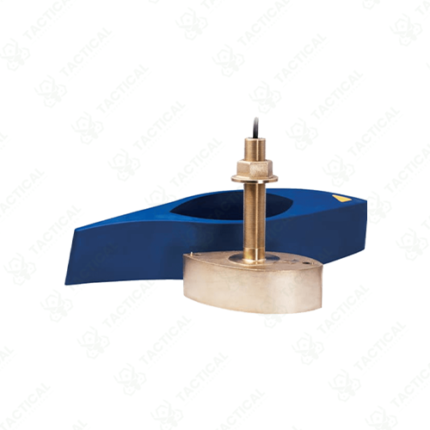
Traditional Sonar Transducers
Traditional sonar transducers convert electrical signals into acoustic pressure waves for transmission into water and convert returning acoustic echoes back into electrical signals for processing, forming the fundamental sensing element in active sonar depth sounding, fish finding, and underwater object detection systems. Naval vessels, hydrographic survey craft, fishing vessels, and port security patrol boats across Pakistan’s coastal and inland water operations use traditional sonar transducers for depth measurement, seabed mapping, and underwater target detection.
The transducer element uses piezoelectric ceramic construction, typically lead zirconate titanate, which changes dimension when voltage applies across its faces and generates voltage when mechanical pressure acts upon it. This reversible electromechanical property allows the same element to function as both transmitter and receiver within the same housing through transmit-receive switching circuits that isolate the sensitive receiver input from the high-voltage transmit pulse. Operating frequencies run from 20 kHz for deep water long-range applications up to 1 MHz for high-resolution shallow water and precision depth measurement work. Additionally, lower frequencies propagate farther through water with less attenuation. Higher frequencies resolve smaller targets and finer seabed features at shorter ranges.
Transducer beam angle determines the cone of water insonified during each pulse transmission. Narrow beam angles between 5 and 12 degrees suit precision depth sounding and target discrimination. Wide beam angles between 20 and 45 degrees cover broader water volume for fish finding and general area detection. Furthermore, mounting configurations include through-hull flush mounting on permanent vessel installations, transom bracket mounting on smaller vessels and survey boats, and portable over-the-side bracket mounting for temporary survey operations from charter and security patrol vessels.
Housing materials use bronze, stainless steel, or composite polymer depending on the deployment environment and corrosion resistance requirements. Bronze suits seawater immersion on permanent installations. Composite polymer suits freshwater inland deployment on river and reservoir survey vessels. Moreover, cable connection uses standard coaxial or twisted-pair configurations with waterproof connector assemblies rated for permanent submersion at depths between 50 and 600 meters depending on housing pressure rating.
Tactical Supply Pakistan supplies traditional sonar transducers to naval vessel equipment programs, hydrographic survey operators, commercial fishing fleet operators, and port security patrol boat outfitters requiring dependable acoustic sensing capability across depth sounding, seabed mapping, and underwater detection applications throughout Pakistan’s coastal and inland water environments.
Showing the single result