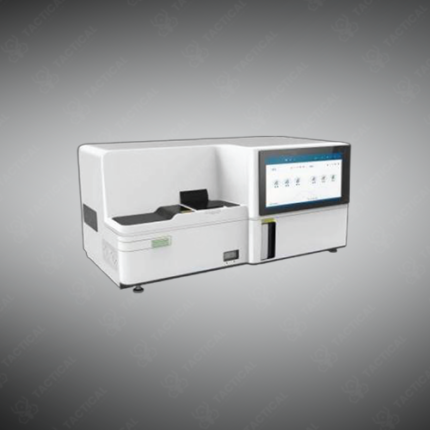
High-Throughput Sequencing
High-Throughput Sequencing, also called next-generation sequencing (NGS), determines the nucleotide sequence of DNA or RNA across millions to billions of fragments simultaneously in a single instrument run, producing gigabases to terabases of sequence data per run at a fraction of the time and cost required by first-generation Sanger sequencing methods.
The sequencing workflow begins with library preparation. The operator fragments the input nucleic acid — genomic DNA, cDNA from RNA, or targeted amplicons — into pieces of 150 to 500 base pairs. Adapter sequences ligate to both ends of each fragment, enabling the fragments to bind to the sequencing flow cell surface and providing primer sites for sequencing chemistry.
On Illumina sequencing platforms — the most widely deployed NGS technology — adapter-ligated fragments bind to complementary oligonucleotides on the flow cell surface and amplify into clonal clusters through bridge amplification. Sequencing by synthesis chemistry then incorporates fluorescently labeled reversible terminator nucleotides one base at a time, imaging the flow cell after each incorporation cycle to record which base added to each cluster. Current Illumina instruments produce read lengths of 75 to 300 base pairs with per-base error rates below 0.1 percent.
Long-read sequencing platforms — Oxford Nanopore and Pacific Biosciences — generate reads of 10,000 to over 1,000,000 base pairs, resolving repetitive genomic regions, structural variants, and full-length transcript isoforms that short-read platforms cannot assemble accurately.
In Pakistan, high-throughput sequencing serves university genomics research programs, hospital infectious disease surveillance, public health pathogen outbreak investigation, agricultural crop improvement programs, forensic DNA profiling units, and pharmaceutical biologic drug development facilities.
Tactical Supply Pakistan supplies high-throughput sequencing instruments, library preparation reagents, and consumables for genomics, clinical, and research procurement across Pakistan.
Showing the single result