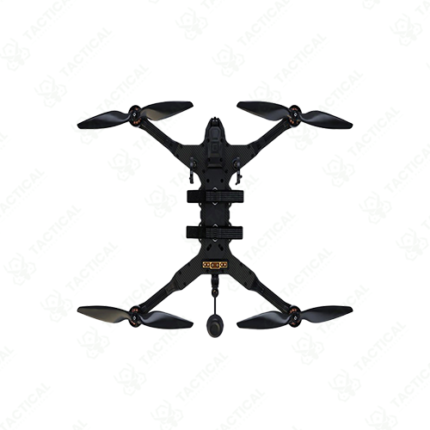
FPV UAV
An FPV UAV (First Person View Unmanned Aerial Vehicle) is a remotely piloted aircraft system operated through a live video stream transmitted from an onboard camera to the pilot’s display goggles or monitor, allowing the operator to navigate and control the aircraft from an immersive first-person perspective rather than observing it from the ground as an external observer. The real-time video link between the airborne camera and the pilot’s viewing system forms the defining operational characteristic of FPV UAVs, enabling precise low-altitude flight, obstacle navigation, and target observation at distances and speeds beyond the limits of unaided visual line-of-sight control.
The UAV platform spans a broad range of airframe configurations — from compact 3-inch to 5-inch quadrotor racing and reconnaissance frames weighing under 400g to larger 7-inch to 10-inch long-range platforms and fixed-wing designs with endurance exceeding 60 minutes. Carbon fiber composite construction is standard across performance-oriented FPV UAV airframes, providing structural rigidity and crash-impact resistance at low weight. Propulsion uses brushless DC motors ranging from 1,800KV to 2,800KV matched to 4S to 6S lithium polymer battery packs, with thrust-to-weight ratios between 4:1 and 10:1 depending on the intended mission profile.
The FPV video system operates on analog or digital transmission protocols — 5.8GHz analog for lowest latency at 1 to 5 milliseconds or digital systems including DJI O3, Walksnail Avatar, and HDZero providing 720p to 1080p HD video with 20 to 28 milliseconds latency at ranges of 5 to 12 kilometers. RC control links use FHSS or DSSS protocols on ExpressLRS 900MHz or 2.4GHz for control ranges of 10 to 40 kilometers on long-range configurations, with encrypted telemetry and video on tactical variants.
Flight controllers running Betaflight or iNAV firmware support both full manual acrobatic control and GPS-aided autonomous modes — position hold, return-to-home, and waypoint navigation — providing operational flexibility across manual close-range reconnaissance and semi-autonomous long-range survey missions.
In Pakistan, FPV UAVs are used across competitive drone racing, aerial cinematography, military reconnaissance, border surveillance, search and rescue operations, and infrastructure inspection by operators requiring agile, real-time aerial visibility.
Tactical Supply Pakistan supplies FPV UAVs across racing, cinematography, reconnaissance, and long-range configurations for sport, professional, and tactical procurement across Pakistan.
Showing the single result