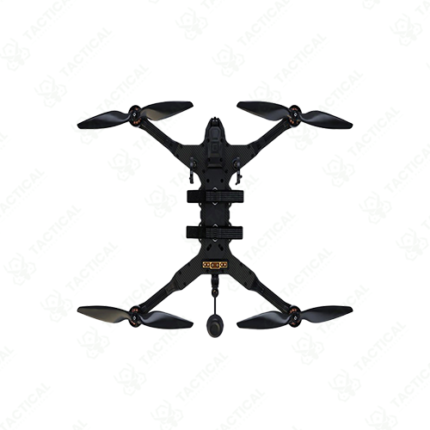
FPV Military Drone
An FPV Military Drone is a first-person view unmanned aerial vehicle built to military performance and durability specifications, operated through a live video feed transmitted to pilot goggles or a command display unit, enabling precise low-altitude navigation and real-time aerial reconnaissance in combat, border surveillance, and special operations environments. Designed for deployment by trained military operators rather than consumer users, these platforms incorporate hardened electronics, encrypted communication links, and operationally relevant payload capacity that distinguish them from commercially available FPV systems.
The airframe uses 3K twill or unidirectional carbon fiber composite construction in motor-to-motor diagonal sizes ranging from 3 inches for compact indoor reconnaissance variants to 10 inches for long-endurance outdoor platforms, with reinforced motor mounts and frame arms rated for crash impact recovery without structural failure during aggressive low-altitude flight. Surface finish uses radar-absorbing matte coating and non-reflective coloration in olive drab, flat black, or terrain-matched patterns to reduce visual and optical detection probability during approach.
Propulsion systems run high-KV brushless motors — typically 1,800 to 2,600KV on 4S to 6S lithium polymer batteries — delivering thrust-to-weight ratios above 6:1 for rapid directional changes and obstacle avoidance at speeds between 80 and 160km/h. Electronic speed controllers (ESCs) with military-grade conformal coating protect against moisture, dust, and temperature extremes across Pakistan’s operational climate range.
The video and control link uses frequency-hopping spread spectrum (FHSS) or direct-sequence spread spectrum (DSSS) encrypted digital protocols on 2.4GHz and 5.8GHz bands, with anti-jamming capability and fallback frequencies programmed into the radio system. Video latency below 28 milliseconds on digital link systems maintains pilot responsiveness during high-speed flight. Control range extends to 5 to 15 kilometers on long-range antenna configurations.
Payload integration mounts support thermal imaging cameras, chemical detection sensors, acoustic collection devices, and on authorized combat variants, precision munition deployment systems.
In Pakistan, FPV military drones are deployed by Pakistan Army reconnaissance elements, special operations units, Counter Terrorism Department tactical teams, and border surveillance forces requiring organic close-range aerial intelligence and target observation capability.
Tactical Supply Pakistan supplies FPV military drones for authorized defense, special operations, and security force procurement across Pakistan.
Showing the single result