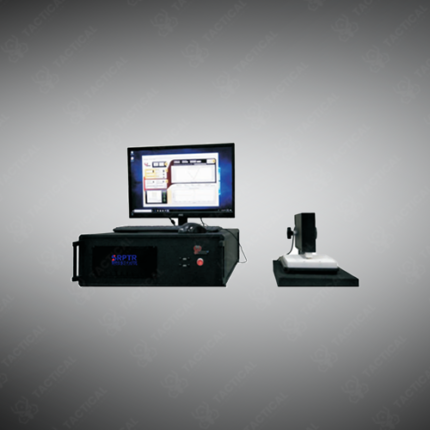
Four Point Probe Resistivity Measurements
Four Point Probe Resistivity Measurements are electrical characterization procedures that determine the sheet resistance and bulk resistivity of conductive, semiconductive, and resistive materials by injecting current through two outer probe contacts and measuring the resulting voltage across two separate inner probe contacts, eliminating contact resistance artifacts that compromise two-probe measurement accuracy. The technique is the industry standard method for resistivity characterization of semiconductor wafers, thin conductive films, transparent conducting oxides, graphene layers, and metallic coatings across research, quality control, and production environments.
The measurement setup positions four probes — typically tungsten carbide or osmium-tipped with radii between 30 and 250 micrometers — at equal spacing s in a collinear arrangement on the sample surface. A precision current source applies a defined current I between the two outer probes, while a high-impedance voltmeter measures voltage V across the two inner probes. For a sample thickness t much smaller than probe spacing, sheet resistance Rs is calculated as Rs = (π/ln2) × (V/I), yielding a value in ohms per square (Ω/□) independent of sample area. Bulk resistivity ρ is derived by multiplying sheet resistance by sample thickness: ρ = Rs × t, expressed in ohm-centimeters (Ω·cm) or ohm-meters (Ω·m).
Geometric correction factors adjust the standard formula for samples of finite dimensions — circular wafers, rectangular coupons, and samples with probe positions near edges — with tabulated correction coefficients applied based on the ratio of sample dimension to probe spacing. Temperature coefficient of resistance measurements require the probe system to be paired with a temperature-controlled chuck or environmental chamber, enabling resistivity characterization as a function of temperature for material classification and quality specification compliance.
Automated mapping systems sweep the probe head across programmed measurement grids on wafer or panel samples, producing spatial resistivity uniformity maps with statistical analysis of mean, standard deviation, and range values across the measured area.
In Pakistan, four-point probe resistivity measurements are performed in university physics and electrical engineering departments, semiconductor device research laboratories, solar cell efficiency characterization facilities, conductive ink and coating development programs, and electromagnetic shielding material qualification testing.
Tactical Supply Pakistan supplies four-point probe resistivity measurement systems and probe heads for materials research, semiconductor characterization, and quality control laboratory procurement across Pakistan.
Showing the single result