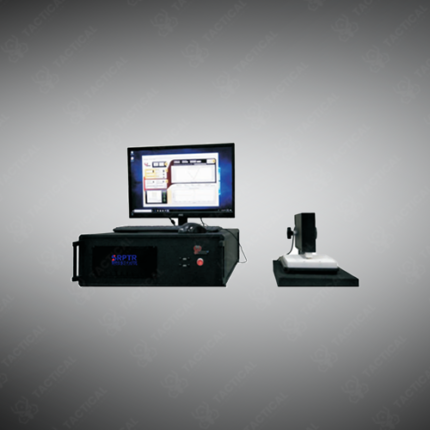
Four Point Probe Resistance System
A Four Point Probe Resistance System is a precision electrical measurement instrument used to determine the sheet resistance and bulk resistivity of thin films, semiconductor wafers, conductive coatings, and flat material samples without the contact resistance errors that affect two-point measurement techniques. By separating the current-injecting contacts from the voltage-sensing contacts into four independently positioned probes arranged in a linear or square configuration, the system eliminates the contribution of probe-to-sample contact resistance from the measured voltage, providing accurate resistance values dependent only on the material’s intrinsic electrical properties.
The standard four-point probe configuration positions four equally spaced tungsten carbide or osmium-tipped probes in a collinear arrangement with probe spacing — typically 0.5mm to 2.0mm — defined by the probe head geometry. A precision current source forces a known DC or AC current through the two outer probes, while a high-impedance voltmeter measures the voltage developed across the two inner probes. Sheet resistance is calculated from the ratio of measured voltage to injected current multiplied by a geometric correction factor — π/ln(2) ≈ 4.532 for an infinite thin sheet under standard probe spacing conditions — yielding a sheet resistance value in ohms per square (Ω/□).
Automated four-point probe systems add a motorized XY stage that moves the probe head across the sample surface in a programmed measurement grid, collecting sheet resistance values at hundreds or thousands of points to generate a spatial resistance uniformity map. This capability is essential for semiconductor wafer quality control, where resistance uniformity across 150mm, 200mm, and 300mm diameter wafers directly reflects dopant distribution consistency during ion implantation and diffusion processing.
Measurement ranges on current instruments span from 1 mΩ/□ for highly conductive metal films to 10⁷ Ω/□ for lightly doped semiconductor layers, with current source compliance voltages up to 100V for high-resistivity samples requiring larger applied voltages to generate measurable current flow.
In Pakistan, four-point probe resistance systems are used in university physics and materials science departments for thin film characterization, electronics research facilities developing conductive coatings, quality control laboratories in solar cell manufacturing, and defense research institutions studying electromagnetic shielding materials.
Tactical Supply Pakistan supplies four-point probe resistance systems for semiconductor characterization, thin film research, and materials science laboratory procurement across Pakistan.
Showing the single result