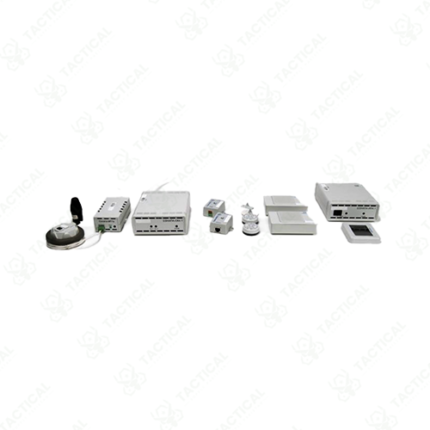
Active Vibroacoustic Control System
An active vibroacoustic control system manages and suppresses unwanted mechanical vibration and structure-borne sound transmission across platforms, vehicles, buildings, or equipment enclosures. Where passive damping relies on material mass and absorption properties alone, active control introduces precisely timed counter-vibration signals through actuators to cancel incoming vibration energy at the source — a process governed by feedforward and feedback control algorithms running on the onboard digital signal processor.
The hardware architecture consists of accelerometers or vibration sensors placed at key structural nodes to measure incoming disturbance, a real-time DSP control unit calculating the required anti-vibration waveform, and electrodynamic or piezoelectric actuators bonded to the structure to inject the cancellation signal. Sensor and actuator placement follows a mapped analysis of the structure’s modal frequencies — typically covering the 1Hz to 500Hz range where mechanical vibration most readily couples into audible sound and structural fatigue.
Performance metrics on active vibroacoustic control systems generally express attenuation in decibels across targeted frequency bands, with well-implemented systems achieving 20dB to 40dB reduction in controlled zones. Response latency of the DSP loop is critical — processing delays above a few milliseconds degrade cancellation effectiveness, particularly at higher frequencies.
In Pakistan, active vibroacoustic control systems are applicable to naval vessel machinery noise reduction, armoured vehicle crew compartment vibration management, sensitive laboratory equipment isolation, and secure facility acoustic hardening where passive treatment alone cannot meet the required attenuation specification.
Tactical Supply Pakistan supports procurement of active vibroacoustic control systems for defence platform integration, facility protection, and technical acoustic management applications.
Showing the single result