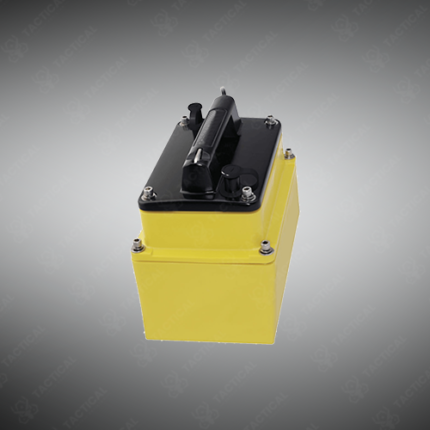
Transducer Chirp
A chirp transducer sends out a sonar signal that sweeps across a range of frequencies within a single pulse, rather than transmitting at one fixed frequency like a traditional transducer. This sweep, typically covering a range like 130-210kHz on mid-range chirp models, gives the returning echo far more detail to work with, since the receiver can separate targets that would otherwise blend together on a single-frequency system. The result shows sharper fish arches, clearer bottom structure, and better target separation even in areas with dense vegetation or thermoclines that confuse standard sonar.
Transducer housing mounts through-hull, on a transom bracket, or inside a trolling motor shaft, depending on boat type and installation preference. Frequency range varies by model purpose, with low chirp settings around 28-60kHz suited to deep water and wide coverage, mid chirp around 130-210kHz balancing depth and detail, and high chirp above 800kHz offering the sharpest resolution at shallower depths. Beam angle typically spans 9 to 25 degrees depending on frequency band, narrower beams giving more precise bottom detail and wider beams covering more area per pass.
Power handling on chirp transducers usually runs higher than traditional models, since sweeping across a frequency range demands more from the internal transmitting element during each pulse cycle. Cable connections use a proprietary or standard connector matching the paired fish finder or sonar display unit, with cable length typically running 6 to 10 metres for standard installations.
Search and rescue teams use chirp transducers to locate submerged objects or missing persons with sharper target definition than older single-frequency sonar allows. Marine survey operations rely on chirp technology for detailed bottom mapping ahead of construction or dredging work. Commercial fishing operations also use chirp sonar to identify fish schools more accurately across varying depths.
Tactical Supply Pakistan supplies chirp transducers to search and rescue teams, marine survey operations, and fishing operations across Pakistan. Frequency range and mounting type are matched to expected water depth and application.
Showing the single result