Tracking / Ranging Radar
Description:
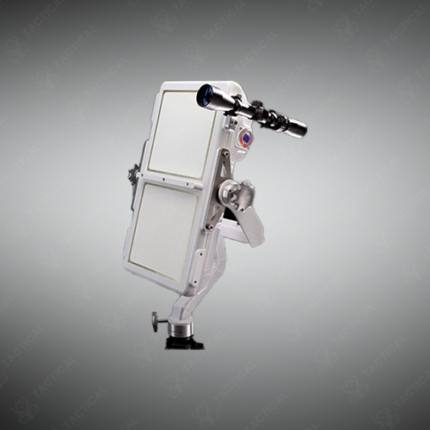
Tracking and ranging radars maintain continuous positional data on a designated target — measuring range, azimuth, elevation, and radial velocity at high update rates to support weapons fire control, missile guidance, air traffic management, space object tracking, and scientific measurement applications. These radars differ from search radars by prioritizing precision and update rate on a single tracked object rather than wide-area detection coverage.
Tracking radars use monopulse angle measurement to determine target bearing precisely in both azimuth and elevation simultaneously from a single pulse. Monopulse processing compares signal amplitude or phase between multiple antenna feed elements — generating angular error signals that drive servo mechanisms keeping the antenna beam centered on the target continuously. Tracking accuracy on military fire control radars reaches milliradians — translating to meter-level position accuracy at ranges of several kilometers. Furthermore, range measurement uses pulse compression waveforms including linear frequency modulation chirp — achieving range resolution of 1 to 5 meters while maintaining detection sensitivity at extended ranges through time-bandwidth product gain.
Fire control tracking radars operate in X-band or Ku-band to achieve the angular resolution needed for precise weapon pointing at aircraft, missile, and drone targets. Track-while-scan (TWS) capability on AESA variants maintains tracks on multiple targets simultaneously while continuing to search for new threats — providing both surveillance and precision tracking from a single radar aperture. Additionally, acquisition radars hand off target tracks to fire control tracking radars — providing an initial target designation that allows the tracking radar to acquire and lock onto the target rapidly without independent search.
Instrumentation tracking radars at test ranges measure missile and projectile trajectories at ranges of 10 to 200 kilometers with accuracies below 1 meter RMS. These provide the precise trajectory data needed for weapons system performance evaluation and flight test safety monitoring. Moreover, coherent Doppler processing on tracking radars measures target radial velocity to accuracies below 0.1 m/s — supporting ballistic target discrimination and projectile velocity measurement.
These radars serve Pakistan Army air defense fire control programs, Pakistan Air Force ground-controlled interception radar networks, Pakistan Navy vessel fire control systems, Pakistan Aeronautical Complex missile test range instrumentation programs, and NESCOM defense electronics radar development projects requiring precision target tracking capability across air defense, fire control, and test range applications.
Tactical Supply Pakistan supplies tracking and ranging radars for air defense fire control, missile test range instrumentation, and naval fire control procurement across Pakistan.
Showing the single result