Time-Domain Reflectometer
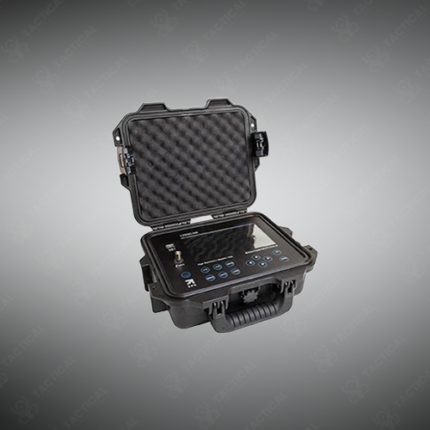
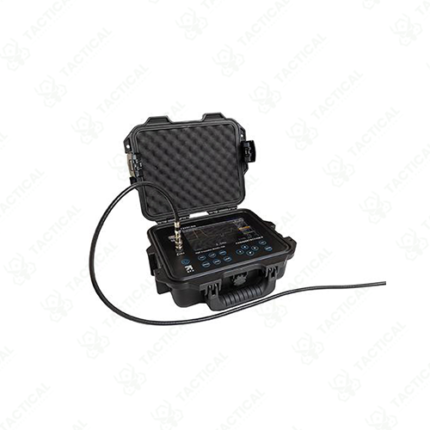
Time-domain reflectometers (TDR) locate faults on cables and transmission lines by sending a fast-rise electrical pulse down the line and measuring the time elapsed before reflected echoes return from impedance discontinuities — converting round-trip travel time into precise fault distance using the cable’s known velocity of propagation. These instruments serve telecommunications cable maintenance, power cable fault location, network infrastructure testing, and military signal corps cable maintenance applications.
The TDR sends a step or impulse waveform down the cable under test. Any impedance change — an open circuit, short circuit, damaged splice, water ingress, connector fault, or cable kink — reflects a portion of the incident pulse back toward the source. The instrument measures the round-trip travel time of the reflected echo. It converts this to distance using the velocity of propagation factor (VOP) entered for the specific cable type. Furthermore, reflection polarity identifies fault type. An open circuit reflects a positive-polarity pulse. A short circuit reflects a negative pulse. Partial faults including moisture ingress and bridged taps produce characteristic partial-reflection signatures recognizable by experienced operators.
Professional TDR instruments such as the Riser Bond 1205CX cover cable lengths from 1 meter to 50 kilometers. Fault location accuracy reaches ±0.1% of cable length on calibrated systems. Distance resolution on high-specification units reaches 0.1 meters — sufficient to locate a fault to within a single cable section between manholes. Additionally, waveform storage functions capture baseline traces on healthy cables for comparison against subsequent measurements — identifying developing faults before service failure occurs.
Dual-port testing measures both conductors of a cable pair simultaneously from a single connection point. Multi-port switching units connect up to 12 cable pairs to a single TDR — enabling systematic fault survey across multiple cables from one test position without cable reconnection between measurements. Moreover, automatic fault classification algorithms on intelligent TDR units identify and label fault types directly on the display — reducing operator interpretation time during high-volume maintenance surveys.
These instruments serve Pakistan Telecommunication Company (PTCL) outside plant cable maintenance teams, fiber optic network contractors, ISP network operations centers in Lahore and Karachi, Pakistan Army signal corps cable maintenance units, and industrial plant telecommunications maintenance departments requiring accurate, rapid cable fault location across copper and coaxial infrastructure networks.
Showing the single result