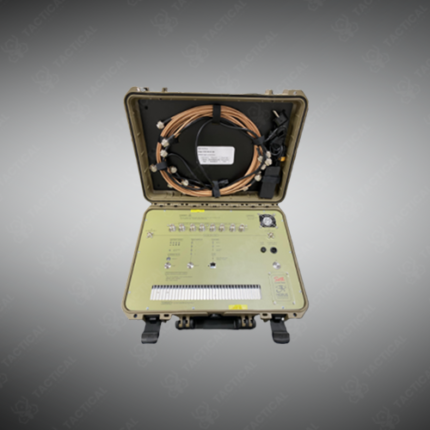
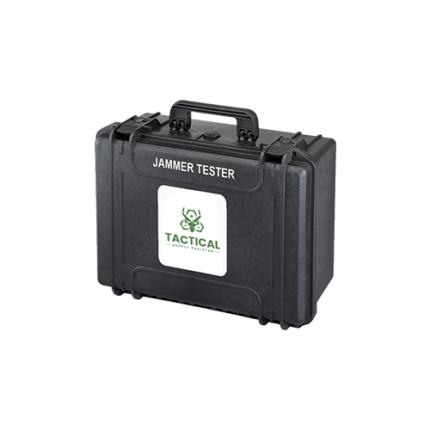
Laser Jammer Testing
Laser jammer testing covers the evaluation, calibration, and performance verification of active laser countermeasure systems fitted to vehicles, aircraft, and ground installations — confirming that jamming heads detect incoming laser threats, respond within specification response times, and transmit jamming signals at correct power levels and modulation patterns before operational deployment. These testing procedures prevent countermeasure failures during actual laser-guided weapon engagements.
Laser jammer test equipment includes calibrated laser threat simulators that replicate the pulse parameters, wavelength, and power levels of operational laser rangefinders and target designators used by adversary fire control systems. Test wavelengths cover 1,064nm Nd:YAG — the most common military rangefinder wavelength — as well as 1,540nm and 532nm sources used by second-generation eye-safe rangefinders and some designator systems. Simulators fire precisely timed pulse trains at specific pulse repetition frequencies (PRFs) matching known threat profiles — allowing technicians to verify that the jammer head detects each threat type and activates the correct jamming response within the specified latency window, typically under 500 microseconds from threat detection to jamming transmission.
Power output verification uses calibrated optical power meters and photodetector arrays positioned at defined standoff distances from the jammer head — measuring actual transmitted jamming irradiance against specification values. Furthermore, angular coverage testing maps the jammer head’s effective detection and response cone by sweeping the threat simulator across azimuth and elevation angles — identifying coverage gaps that would leave vehicle approaches unprotected. Spectral response testing confirms the jammer’s photodetector sensitivity across the full threat wavelength range rather than only at the primary calibration wavelength.
Environmental testing subjects jammer heads to temperature cycling from -40°C to +70°C, vibration profiles matching vehicle operational environments, and humidity exposure — verifying performance stability across the full deployment environment. Additionally, electromagnetic compatibility (EMC) testing confirms that jammer operation does not interfere with co-located vehicle electronics, radio systems, or navigation equipment.
These testing capabilities apply directly to Pakistan Army armored vehicle laser warning and countermeasure system qualification programs, Pakistan Air Force aircraft self-protection suite acceptance testing, and Pakistan Navy vessel electro-optical countermeasure system verification at maintenance and overhaul facilities across Rawalpindi, Karachi, and Kamra.
Tactical Supply Pakistan supplies laser jammer testing equipment for countermeasure system qualification, performance verification, and acceptance testing procurement across Pakistan.
Showing the single result