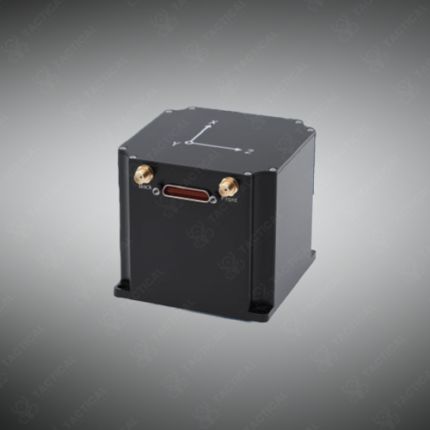
Inertial Fiber Optic Gyro Navigation System
Inertial fiber optic gyro (FOG) navigation systems determine position, velocity, and orientation using light rather than mechanical components. Three fiber optic gyroscopes measure rotational rate around each axis while MEMS accelerometers capture linear acceleration across all three axes simultaneously. Together these six measurements provide continuous six-degrees-of-freedom (6DOF) navigation output without relying on external signals — making FOG INS the primary navigation solution in GNSS-denied, jammed, or contested environments.
FOG technology works by splitting a laser beam and sending each half in opposite directions around a coil of optical fiber. Rotation causes a measurable phase difference between the two beams — the Sagnac effect. As a result, FOG gyroscopes carry no moving parts, wear out significantly slower than mechanical gyros, and deliver gyro bias stability as low as 0.003°/hr on navigation-grade units. Tactical-grade FOG systems achieve heading accuracy below 0.03° and position drift rates in the range of 1–5 nautical miles per hour during pure inertial navigation without GNSS aiding.
Systems such as the Inertial Labs INS-DM-FI combine tactical-grade FOG technology with multi-constellation GNSS receivers supporting GPS, GLONASS, Galileo, QZSS, and BeiDou. An IP68-rated housing and full EMI shielding protect the unit in harsh field environments. Furthermore, integrated anti-jamming and anti-spoofing algorithms maintain navigation accuracy when hostile electronic warfare environments degrade GNSS signal quality. The EMCORE TACNAV IIc adds battlefield management system (BMS) integration capability — functioning as the navigation core for armored vehicle command systems. Advanced Navigation’s Digital FOG INS (DFOG) achieves strategic-grade performance with a 40% reduction in size using an AI-based sensor fusion algorithm.
Output data includes position, velocity, heading, pitch, roll, and heave at update rates up to 1,000Hz — directly interfacing with fire control systems, weapon stabilization platforms, radar systems, and autopilots via RS-232, RS-422, CAN bus, and Ethernet.
These systems apply directly to Pakistan Army armored vehicle navigation programs, Pakistan Navy surface vessel gyrocompass requirements, JF-17 avionics upgrade programs at Pakistan Aeronautical Complex, and artillery weapon system alignment applications requiring GNSS-independent orientation reference across Pakistan’s mountainous and electronically contested operational environments.
Tactical Supply Pakistan supplies inertial fiber optic gyro navigation systems for armored vehicle navigation, weapons stabilization, and GNSS-denied platform guidance procurement across Pakistan.
Showing the single result