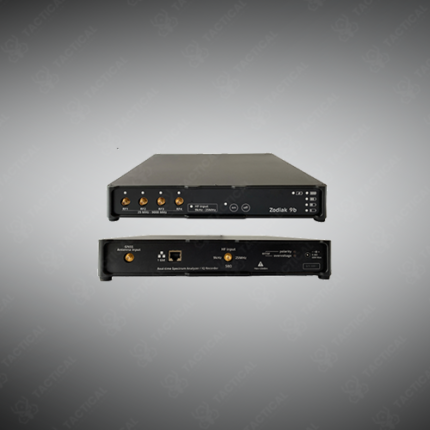
Sound Frequency Analyzer
Sound frequency analyzers measure and display the frequency content of acoustic signals in real time, breaking down complex sound into its component frequency bands to identify noise sources, assess acoustic environments, and verify compliance with noise exposure regulations. Industrial noise monitoring teams, occupational health safety officers, acoustic engineers, and military facility managers across Pakistan use sound frequency analyzers to characterize noise environments at manufacturing plants, shooting ranges, aviation facilities, and urban construction sites.
The analyzer captures sound through a calibrated measurement microphone and processes the incoming signal through a bank of digital filters. Each filter passes only the frequency content within its defined bandwidth, producing a level reading for each frequency band simultaneously. Octave band analyzers divide the audible frequency range from 20 Hz to 20 kHz into nine standard octave bands centered at 31.5 Hz, 63 Hz, 125 Hz, 250 Hz, 500 Hz, 1 kHz, 2 kHz, 4 kHz, and 8 kHz. One-third octave band analyzers divide the same range into 30 narrower bands for more detailed frequency characterization. Additionally, fast Fourier transform analyzers on advanced models compute narrow-band spectra at frequency resolutions below 1 Hz, identifying individual tonal components and machinery harmonics that octave band analysis does not resolve.
Measurement weighting networks apply A-weighting, C-weighting, or Z-weighting to incoming signals before level calculation. A-weighting matches human hearing sensitivity across frequency and suits occupational noise exposure assessment. C-weighting suits peak impulse noise measurement at shooting ranges and blast events. Furthermore, real-time display modes show the live frequency spectrum as a bar chart or line graph updating at rates between 10 and 50 times per second. Data logging stores time-stamped octave band level records at user-defined intervals for post-measurement analysis and regulatory reporting.
Calibration uses a standard acoustic calibrator producing a 1 kHz tone at 94 dB or 114 dB to verify microphone sensitivity before each measurement session. Moreover, Class 1 and Class 2 instrument grades follow IEC 61672 standards, with Class 1 instruments meeting tighter tolerance specifications for regulatory compliance measurements and legal noise dispute documentation.
Tactical Supply Pakistan supplies sound frequency analyzers to industrial noise control engineers, occupational health safety teams, military facility acoustic managers, and environmental noise monitoring agencies requiring detailed frequency-domain acoustic measurement capability across industrial, military, and environmental noise assessment applications throughout Pakistan.
Showing the single result