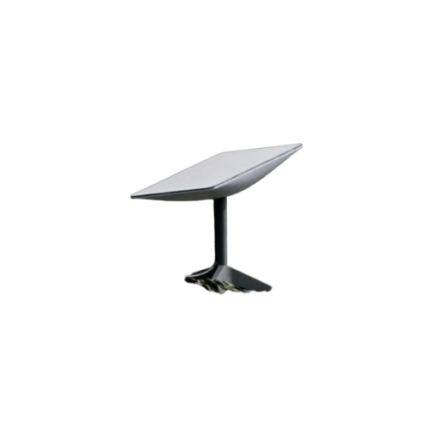
Satellite Signal Jamming
Satellite signal jamming transmits high-power RF energy on the uplink or downlink frequencies used by satellite communication and navigation systems — denying, degrading, or disrupting the ability of adversary forces, hostile platforms, and unauthorized users to receive or transmit through satellite infrastructure. This electronic warfare capability targets GPS navigation, satellite communications (SATCOM), and satellite-based data links that modern military and commercial systems depend on for command, control, and positioning.
Uplink jamming targets the ground station transmitter frequencies used to send commands or data to a satellite — disrupting the signal before it reaches the spacecraft. Effective uplink jamming requires high transmit power and directional antenna systems pointed accurately at the satellite’s orbital position. Downlink jamming transmits on the frequencies the satellite broadcasts to ground receivers — a lower-power approach since the jammer operates near the target receivers rather than needing to reach the satellite altitude. Furthermore, GPS downlink jamming is the most widely deployed satellite signal jamming technique. A broadband or spot-frequency jammer transmitting on L1 at 1,575.42MHz and L2 at 1,227.60MHz overpowers the extremely weak GPS satellite signals — preventing receivers within the jamming footprint from obtaining a navigation solution.
Spot jamming concentrates all transmit power on a single target satellite frequency. Sweep jamming moves across multiple frequencies sequentially. Barrage jamming transmits across a wide bandwidth simultaneously — covering multiple satellite frequency bands at reduced power spectral density per frequency. Additionally, meaconing attacks retransmit delayed satellite navigation signals — causing receivers to compute incorrect position solutions without triggering the receiver integrity monitoring that detects pure jamming. This technique blends elements of jamming and spoofing — making it more difficult for the target to characterize and counter than straightforward noise jamming.
Counter-jamming measures include null-steering antenna arrays that place signal reception nulls in the jammer’s direction while maintaining gain toward the satellite, anti-jam GPS receivers with military P(Y) or M-code signal processing, and inertial navigation system (INS) integration that bridges GPS outages using dead reckoning during jamming events.
These capabilities apply to Pakistan Army electronic warfare programs, NESCOM defense research into satellite signal vulnerability assessment and counter-jamming system development, Pakistan Air Force electronic warfare training programs, and university electrical engineering departments in Lahore and Karachi studying satellite communication security and electronic warfare system design.
Tactical Supply Pakistan supplies satellite signal jamming systems and counter-jamming equipment for electronic warfare training, GNSS vulnerability testing, and military communications security procurement across Pakistan.
Showing the single result