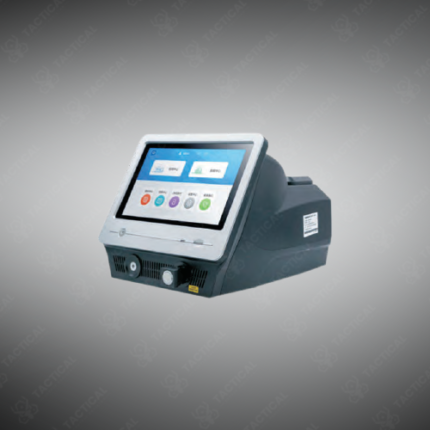
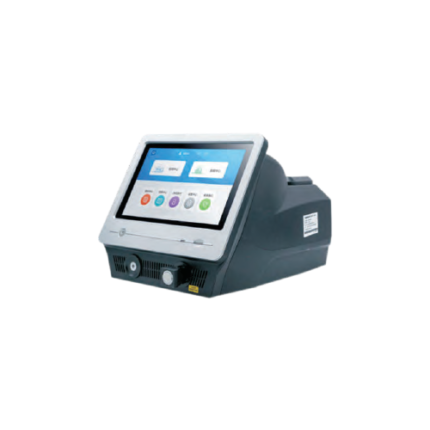
Raman Spectrometer
Raman spectrometers identify chemical compounds by analyzing the inelastic scatter of laser light from a sample surface, producing a spectral fingerprint that matches against reference libraries to deliver compound identification results without physical contact, sample preparation, or destructive testing of the material under examination. Forensic investigators, pharmaceutical analysts, security inspection teams, and industrial quality control personnel across Pakistan use Raman spectrometers to identify unknown substances, verify material composition, and detect adulteration in field and laboratory settings.
The instrument directs a continuous wave laser onto the target sample at excitation wavelengths including 532nm, 633nm, 785nm, or 1064nm depending on sample type and fluorescence sensitivity requirements. Raman scatter returning from the sample passes through a notch or edge filter that rejects the intense Rayleigh scatter at the excitation wavelength, allowing only the weak wavelength-shifted Raman signal to reach the detector array. Spectral coverage runs between 200 and 3200 wavenumbers per centimeter on most analytical Raman instruments, with spectral resolution between 1 and 8 wavenumbers per centimeter depending on spectrometer grating density and detector pixel count. Additionally, back-thinned CCD detector arrays on laboratory instruments and linear InGaAs arrays on 1064nm excitation models provide the detection sensitivity necessary to capture weak Raman signals from samples at low laser power to minimize photodegradation.
Measurement configurations include direct contact probe sampling, non-contact standoff measurement at distances between 5mm and 100mm, through-container measurement penetrating clear glass and plastic packaging up to 5mm wall thickness, and microscope-coupled imaging for spatially resolved chemical mapping across sample surfaces. Furthermore, onboard spectral libraries in portable field instruments cover thousands of compounds including explosives, narcotics, pharmaceutical actives, chemical warfare agent simulants, toxic industrial chemicals, food adulterants, and polymer identification references, with automated matching algorithms returning identification results within 15 to 45 seconds of spectrum acquisition.
Data output includes spectrum plots, library match results with confidence scores, GPS-tagged location records, and operator credential fields for chain-of-custody documentation. Moreover, laboratory-grade Raman spectrometers connect to external workstations through USB or Ethernet, running advanced chemometric software for mixture analysis, quantitative concentration determination, and multivariate spectral classification tasks beyond the capability of onboard identification algorithms.
Tactical Supply Pakistan supplies Raman spectrometers to forensic laboratories, border security agencies, anti-narcotics forces, pharmaceutical quality control departments, and industrial inspection programs requiring chemical compound identification capability across field and laboratory analytical applications throughout Pakistan.
Showing the single result