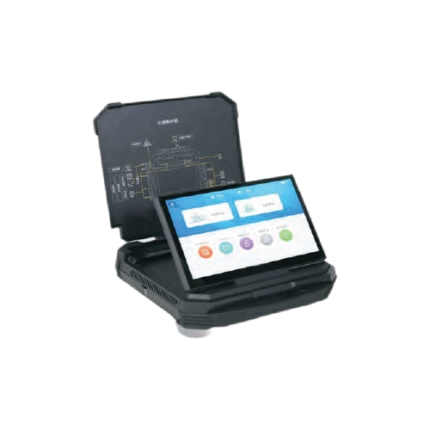
Portable Raman Spectrometer Food Safety Detection
Portable Raman spectrometers configured for food safety detection identify adulterants, contaminants, and prohibited additives in food and agricultural products at inspection points, storage facilities, and border crossing checkpoints without requiring laboratory sample transport or destructive testing of the inspected product. Food safety authorities, customs inspection agencies, and quality control teams across Pakistan use these instruments to screen incoming food imports, bulk commodity shipments, and packaged consumer products for melamine, Sudan dyes, pesticide residues, undeclared starch additions, and other economically motivated adulterants.
The measurement process directs a focused near-infrared laser, typically at 785nm or 1064nm excitation wavelength, onto the food sample through transparent packaging film or directly onto an exposed sample surface. Raman scatter collected from the sample produces a spectral fingerprint that reflects the molecular composition of the material, with adulterant compounds producing characteristic peaks at specific wavenumber positions that the onboard algorithm detects even when present at low concentration within a complex food matrix. Additionally, 1064nm excitation wavelength selection suppresses fluorescence background generated by naturally colored food matrices including spices, edible oils, fruit juices, and herbal products that cause strong interference at shorter excitation wavelengths and prevent accurate adulterant detection in these challenging sample types.
Detection sensitivity for common food adulterants runs between 0.1% and 1% by weight concentration depending on the adulterant compound and food matrix, with melamine in milk powder and Sudan dye in chili powder among the validated detection capabilities in current food safety Raman library databases. Furthermore, through-packaging measurement allows screening of sealed retail and bulk packaging without opening containers, maintaining product integrity during inspection and reducing contamination risk during the screening process.
Onboard food safety libraries cover dozens of common adulterants, prohibited dyes, and undeclared additives, with identification results and match confidence scores displaying within 20 to 45 seconds of spectrum acquisition. Moreover, result records store with product lot information, GPS coordinates, timestamp, and operator credentials for regulatory documentation and traceability reporting requirements.
Tactical Supply Pakistan supplies portable Raman spectrometers for food safety detection to Pakistan Standards and Quality Control Authority inspection teams, customs food inspection units, port health authorities, and food manufacturing quality control departments requiring field-deployable adulterant detection capability across food import and domestic supply chain inspection operations throughout Pakistan.
Showing the single result