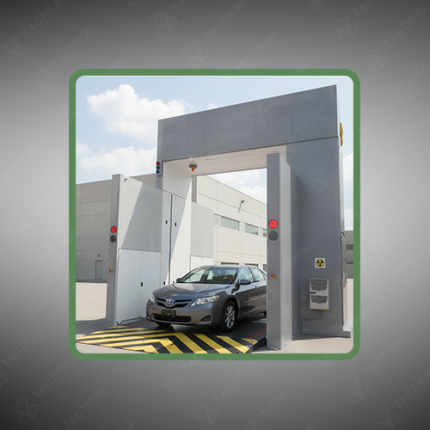
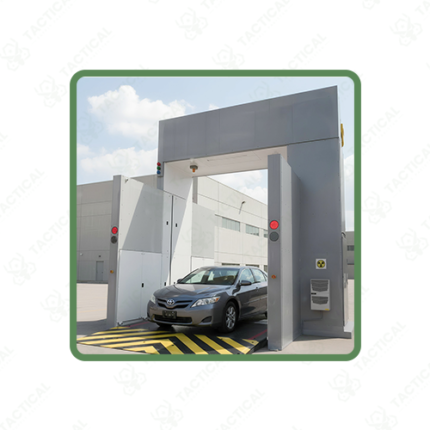
Passive Vehicle Screening System (VX-Ray)
Passive Vehicle Screening Systems, designated VX-Ray, inspect cars, vans, trucks, and other road vehicles for concealed weapons, explosives, and contraband without requiring occupants to exit or the vehicle to undergo manual search procedures. Drive-through portal configurations allow vehicles to pass through the screening zone at low speed, with imaging systems capturing undercarriage, cabin, and cargo area content during a single transit pass, maintaining checkpoint throughput while delivering non-invasive threat detection across all vehicle classes.
The portal frame houses backscatter X-ray or transmission X-ray emitter and detector arrays configured to cover the full vehicle cross-section from multiple angles during transit. Transmission systems project X-rays through the vehicle body and capture attenuated beam intensity on detector panels positioned opposite the source, producing density-mapped images that reveal concealed objects within door panels, seat cavities, spare wheel wells, and modified fuel tanks. Additionally, backscatter configurations capture X-rays scattered back toward the source side, producing surface-detail images of vehicle exteriors and occupant body profiles that complement transmission data for comprehensive content assessment. Radiation dose per vehicle pass stays within internationally accepted limits, typically below 1 microsievert per screening event.
Image resolution allows operators to distinguish metallic weapons, organic explosive materials, and plastic-cased contraband packages within vehicle cavities at belt speeds between 5 and 15 km/h through the portal. Furthermore, automatic threat detection algorithms analyze captured images in real time, flagging suspicious density profiles and shape signatures for operator review without requiring manual image assessment of every vehicle passing through the system during high-volume screening operations.
Throughput capacity reaches 200 to 400 vehicles per hour on standard portal configurations, supporting deployment at busy border crossing points, cantonment entry gates, and stadium vehicle access lanes. Moreover, all screening images store automatically with vehicle registration camera capture, timestamp, lane identifier, and operator credentials for full audit trail documentation.
Tactical Supply Pakistan supplies Passive Vehicle Screening Systems to border management agencies, military installation security, law enforcement checkpoint operators, and critical infrastructure protection units requiring high-throughput non-invasive vehicle inspection capability across Pakistan.
Showing the single result