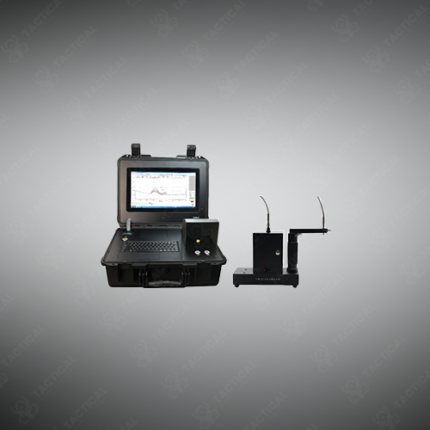
Optical Spectrometer
Optical spectrometers measure the intensity of light as a function of wavelength — generating spectra that reveal the chemical composition, physical properties, and concentration of materials through their characteristic absorption, emission, reflection, or scattering signatures. These instruments serve analytical chemistry, materials science, pharmaceutical quality control, environmental monitoring, forensic analysis, and defense sensing across UV, visible, and near-infrared wavelength ranges.
The core spectrometer architecture disperses incoming light into its component wavelengths using a diffraction grating or prism. A detector array — CCD, CMOS, or InGaAs photodiode array — captures the dispersed spectrum simultaneously across all wavelengths in a single measurement without scanning. Wavelength range on compact miniature spectrometers covers 200nm to 1,100nm on silicon detector systems and extends to 2,500nm on InGaAs arrays — covering the full UV-visible-NIR analytical window relevant to most chemical identification and material characterization applications. Furthermore, optical resolution determines the minimum wavelength separation the spectrometer resolves between adjacent spectral features. High-resolution spectrometers achieve 0.1nm FWHM — resolving closely spaced atomic emission lines in elemental analysis. Lower-resolution broadband spectrometers achieve 1 to 5nm FWHM — sufficient for molecular absorption and NIR reflectance measurements.
Miniature USB-connected spectrometers such as the Ocean Insight USB2000+ and Avantes AvaSpec series weigh under 500 grams. They connect directly to laptop computers and tablets — enabling field-deployable spectroscopic measurement without laboratory infrastructure. Additionally, benchtop research spectrometers use larger optical benches with higher f-number collection optics. These deliver higher sensitivity and resolution for trace-level analytical applications including Raman scattering, fluorescence quantum yield measurement, and thin-film optical characterization.
Fiber optic input ports accept standard SMA-905 connectors — coupling to immersion probes, reflectance probes, and remote sampling accessories for in-situ measurement without moving the sample to the instrument. Trigger input and output connectors synchronize spectral acquisition with pulsed light sources, laser pulses, and external experimental events in time-resolved measurement applications.
These spectrometers serve Pakistan’s pharmaceutical analytical quality control laboratories in Karachi and Lahore, PCSIR materials research centers, forensic science laboratories at PFSA and FIA, university chemistry and physics research departments, and defense electronics optical sensor development programs at NESCOM and SUPARCO requiring wavelength-resolved optical measurement across a wide range of analytical and sensing applications.
Showing the single result