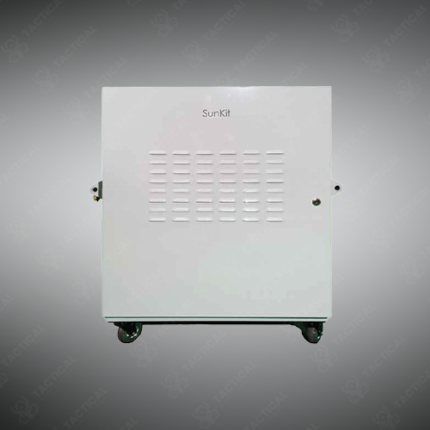
Off-Grid Solar Power System
Off-grid solar power systems generate, store, and distribute electrical energy independently of the national grid — providing reliable power to remote locations, forward operating bases, disaster response sites, and rural communities where grid connection is unavailable, unreliable, or operationally impractical.
The system consists of four core components working together. Solar panels convert sunlight into DC electricity using monocrystalline or polycrystalline silicon cells. Monocrystalline panels achieve efficiency ratings of 20 to 23% — producing more power per square meter than polycrystalline alternatives at equivalent panel area. Furthermore, a solar charge controller regulates the voltage and current flowing from the panels to the battery bank — preventing overcharge, over-discharge, and reverse current flow that shorten battery service life. Maximum power point tracking (MPPT) controllers extract up to 30% more energy from the panel array compared to older PWM controllers under variable sunlight and temperature conditions.
Battery banks store generated electricity for use during nighttime and cloudy periods. Lithium iron phosphate (LiFePO4) batteries deliver 2,000 to 6,000 charge cycles at 80% depth of discharge — significantly outlasting lead-acid alternatives in systems cycled daily. Additionally, a pure sine wave inverter converts stored DC battery voltage to 220V AC output at 50Hz, powering standard appliances, medical equipment, communications systems, and industrial loads without the harmonics that modified sine wave inverters introduce on sensitive electronics.
System sizing covers panels from 200W on compact individual-use systems to 50kW and above on base camp and community power installations. Battery capacity scales from 1kWh on portable systems to 500kWh on fixed military and industrial installations. Moreover, hybrid systems add a diesel generator backup that activates automatically when battery state of charge drops below a programmed minimum — maintaining continuity during extended low-sunlight periods.
These systems serve Pakistan Army forward operating bases in northern mountain terrain, Frontier Corps posts along Pakistan’s western border, disaster relief operations by NDMA, rural electrification programs in off-grid villages across Balochistan and Gilgit-Baltistan, and telecom tower power infrastructure in areas without reliable grid supply.
Tactical Supply Pakistan supplies off-grid solar power systems for military forward bases, rural electrification, disaster relief, and telecom infrastructure procurement across Pakistan.
Showing the single result