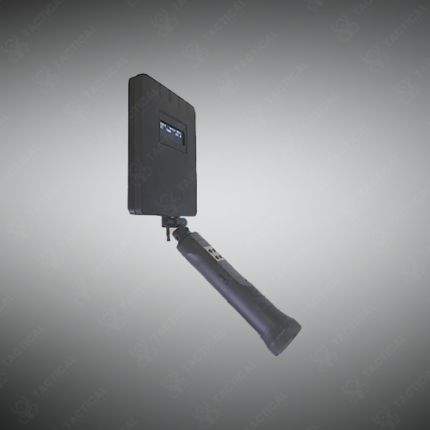
Handheld Direction-Finding Antenna
A handheld direction-finding antenna is a portable radio frequency sensing instrument used to determine the bearing to an active RF transmitter by detecting the directional variation in received signal strength or phase as the antenna is rotated or moved through space. The operator sweeps the antenna across a horizontal arc while monitoring signal level on an attached receiver or integrated display, identifying the bearing direction that produces the strongest received signal or the characteristic null response depending on the antenna type and direction-finding technique employed.
Antenna designs used in handheld direction finding include Yagi arrays for high-gain narrow-beam bearing on VHF and UHF frequencies, loop antennas exploiting their figure-eight reception pattern to identify bearing nulls with high angular precision, and Adcock arrays providing omnidirectional phase comparison for automated bearing computation. Operating frequency coverage varies by antenna design, with broadband handheld DF antennas covering ranges from 20 MHz to 3 GHz or wider on wideband TSCM-grade instruments. Angular accuracy on professional handheld DF systems reaches 1 to 3 degrees RMS under favorable propagation conditions.
Tactical Supply Pakistan supplies handheld direction-finding antennas and supporting receiver systems for TSCM, military signals, law enforcement, and spectrum management applications across Pakistan.
Showing the single result