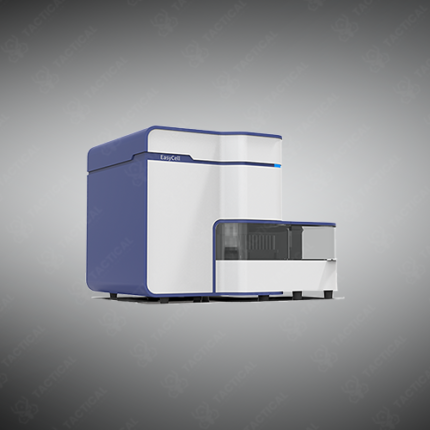
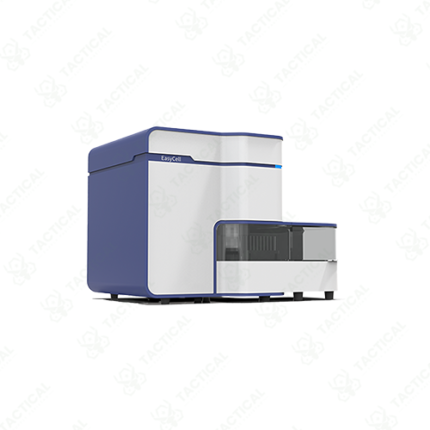
Flow Cytometry Instruments
Flow Cytometry Instruments are laboratory platforms that analyze the optical and fluorescence properties of individual cells or particles passing through focused laser beams in a hydrodynamically controlled fluid stream, generating multi-parameter single-cell data used for immunophenotyping, cell cycle analysis, apoptosis detection, viability assessment, and intracellular protein quantification. The instrument category spans benchtop clinical analyzers optimized for high-throughput diagnostic workflows to high-parameter research systems supporting complex multi-color panel designs in basic and translational science applications.
The instrument architecture centers on three integrated subsystems. The fluidics module creates and maintains the hydrodynamic focusing that aligns cells into single-file passage through the laser interrogation zone, with sheath fluid flow rates and sample pressure differentials controlling the core stream diameter — typically 10 to 20 micrometers — and the rate of cell presentation to the optical bench. The optics module houses the laser sources, beam-shaping optics, dichroic mirror arrays, and bandpass filter sets that direct specific wavelength bands of scattered and emitted light to dedicated detector channels. The electronics module converts analog photomultiplier tube (PMT) or avalanche photodiode signals into digital pulse data, applying threshold discrimination, compensation matrices, and gating logic to classify and record each detected event.
Laser configurations on current flow cytometry instruments range from single 488nm blue laser platforms with 4 to 6 detection channels for routine CD4 counting and basic panel work, to 5-laser systems with 25 to 50 channels for high-dimensional immunology research. Spectral flow cytometers replace conventional bandpass filter arrays with full-spectrum prism or grating detectors capturing complete emission profiles per fluorochrome, enabling larger panel sizes through computational unmixing rather than hardware filter optimization.
Microfluidic and acoustic focusing technologies in newer compact instrument designs reduce instrument size to desktop footprints while maintaining analytical performance comparable to larger conventional systems, extending flow cytometry access to smaller diagnostic laboratories and field research stations.
In Pakistan, flow cytometry instruments are installed in tertiary hospital immunology and hematology laboratories for HIV staging, leukemia diagnosis, and transplant workup, as well as in pharmaceutical manufacturing quality control departments and university research centers conducting cellular immunology and oncology studies.
Tactical Supply Pakistan supplies flow cytometry instruments across clinical analyzer, research platform, and cell sorter configurations for diagnostic and laboratory procurement across Pakistan.
Showing the single result