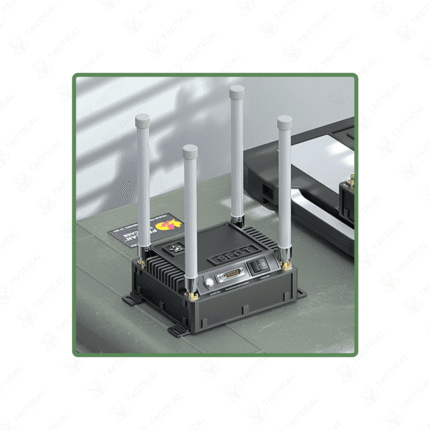
Ip Mesh Module Mimo
-
Mesh Network Topology: These modules support self‑forming, self‑healing mesh networks — meaning each node can relay data for others, enabling flexible deployment without a fixed infrastructure. For example: “supports up to 10 hops and 50 nodes” in a 5 GHz dual‑channel MIMO mesh module.
-
MIMO Technology: Multiple‑Input/Multiple‑Output (e.g., 2×2 MIMO) antennas and radio chains improve throughput, reliability and range by exploiting spatial diversity and transmitting/receiving on multiple antennas. For example: a module lists “MIMO dual‑channel Mesh network … Output Power 30dBm (MIMO 2×2)”.
-
High Data Throughput & Configurable Bandwidth: These modules often offer configurable RF bandwidths (5/10/20/40 MHz) and data rates up to ~96 Mbps in certain configurations (e.g., 5 GHz band).
-
Interfaces & Integration: They typically provide Ethernet ports (RJ45), USB or serial interfaces, and antenna connectors (MMCX or SMA) to enable integration into larger systems, vehicles or unmanned platforms. Example: “MMCX2, 100M RJ452, … USB1 … MiniPCI‑E1”.
-
Security & Ruggedness: Features such as AES encryption, industrial temperature ranges (‑40°C to +65°C or more), broad voltage input and rugged modules/IP ratings are common for use in harsh conditions (e.g., UAVs, emergency, remote).
-
Deployment Scenarios & Flexibility: These modules are suited for many applications: UAV/UGV communication, mobile/vehicle installations, body worn,
Showing the single result