


Blog
Unmanned Aerial Vehicles: Engineering the new face of Air Combat

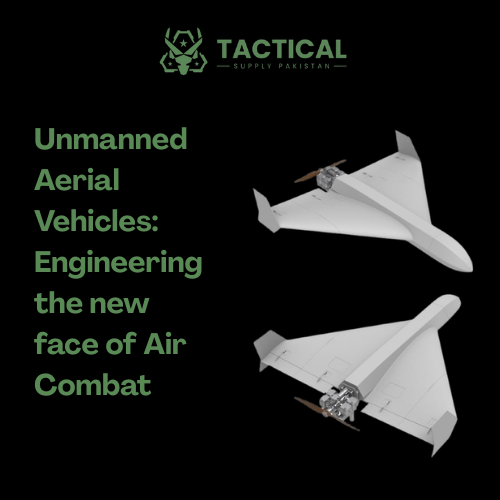
Unmanned Aerial Vehicles have moved from a supporting role to a central pillar of force structure in less than two decades. What began as remotely piloted reconnaissance aircraft has branched into armed combat drones, tube-launched munitions that loiter until a target presents itself, and lightweight surveillance systems that give a forward patrol the situational awareness once reserved for a squadron headquarters.
Across the Air Force, Army, Navy, Marine Corps, Special Operations Forces, Artillery Commands, and Intelligence Units, the question is no longer whether to invest in Unmanned Aerial Vehicles, but which category answers a specific operational requirement and how it integrates with existing infrastructure. Tactical Supply Pakistan approaches these questions with the technical grounding that informed procurement requires, and this guide reflects that same depth of understanding.
Orienting the Spectrum
Naming conventions in this industry overlap more than expected. Two points matter before going category by category: “loitering munitions” and “kamikaze drones” describe the same weapon concept an expendable, warhead-carrying Unmanned Combat Aerial Vehicles. And the two surveillance payload categories are not aircraft at all; they are the sensor packages that give every platform above them its ability to see and designate a target. Comparing an airframe against a payload as if they compete is a common evaluation mistake.
UCAV (Unmanned Combat Aerial Vehicle) System: Strike and Persistent ISR
A UCAV (Unmanned Combat Aerial Vehicles) are armed, reusable Unmanned Combat Aerial Vehicles that carries ordnance air-to-surface missiles, guided bombs, and in newer designs, air-to-air weapons while retaining reconnaissance and loitering endurance. It loiters over an area using electro-optical/infrared sensors, streams imagery to a ground control station, and holds ordnance in reserve until a target is confirmed and cleared. Because it is unmanned, it sustains that loiter well beyond a crewed aircraft’s limits without risking aircrew.
The advantage is persistent strike capability at a lower cost per flight hour than a comparable manned platform. The limitation is datalink dependency, which creates vulnerability to jamming, and modest speed relative to fighter aircraft, which limits survivability against modern air defences without stealth shaping or stand-off weapons.
The category has matured considerably in recent years, with autonomous “loyal wingman” style aircraft increasingly flying alongside crewed fighters, and beyond-visual-range air-to-air engagement now being demonstrated from unmanned airframes in flight testing. Evaluation typically centres on datalink resilience under jamming, weapons integration flexibility, sensor turret resolution, and the ground-station and maintenance infrastructure required to sustain the platform.
Tactical UAV System: The Backbone of Battlefield ISR
Where a UCAV centres on strike, a Tactical UAV System centres on reconnaissance, surveillance, and target acquisition (RSTA) the workhorse category by unit count in most force structures. Launched by catapult, rail, or short runway, these platforms orbit an area of interest while a ground control station receives live video and telemetry, covering anything from close-range reconnaissance to wide sector coverage along a border or front.
Tactical Unmanned Combat Aerial Vehicles are inexpensive to operate relative to manned reconnaissance and can be dispersed across many units at once. Their limitation is endurance and payload capacity compared to Medium-Altitude Long-Endurance platforms, so they complement rather than replace larger ISR assets. The clearest modernization trend is a shift toward hybrid VTOL variants that eliminate the need for a prepared runway — valuable for forward bases and naval detachments with limited space alongside open architectures that allow sensor payloads to be swapped without replacing the airframe.
Key evaluation factors include mean time between failures, field-level maintainability, operator training burden, and critically direct interoperability with existing artillery fire-control and command systems, since a manual data-handoff step slows the sensor-to-shooter timeline.
Hybrid VTOL Surveillance Unmanned Combat Aerial Vehicles: Runway-Independent Persistent Watch
A Hybrid VTOL Surveillance UAV combines rotary-wing vertical launch and recovery with fixed-wing cruise efficiency taking off vertically, transitioning to wing-borne flight for endurance, and landing vertically without a runway, catapult, or arrestor system. Once in cruise, it behaves like a conventional fixed-wing Unmanned Combat Aerial Vehicle, orbiting a target area while its EO/IR gimbal streams day and night imagery.
The clear advantage is deployment flexibility: launch from a ship deck, a confined forward base, or rugged terrain where no runway exists. The trade-off is mechanical complexity more motors and flight modes mean more potential failure points, and generally more constrained payload capacity than a runway-launched tactical UAV of similar size. This makes the category especially valuable for coastal and maritime surveillance, border monitoring in roadless terrain, and rapid-deployment ISR for special operations units. Evaluation should weigh transition reliability in crosswinds, payload-versus-endurance trade-offs, and modularity for future sensor upgrades, given the added mechanical complexity these platforms carry.
Loitering Munitions and Kamikaze Drones: Precision Strike Through Persistence
These describe the same category: a self-contained UAV carrying a warhead, built to loiter over an area, search for or wait on a designated target, and dive into it to detonate. Unlike a missile fired at a known coordinate, a loitering munition holds position over a target area, allowing positive identification of a target and in many systems, an abort mid-dive if the picture changes.
Most systems are tube-launched, canister-deployed, or hand-thrown, deploying wings or rotors after launch, then using an onboard EO/IR sensor to locate the target or receive updated coordinates before a terminal dive. The advantage is cost-effective precision comparable to a guided missile at a fraction of the unit cost, with the persistence to wait for a fleeting target. The limitation is payload size smaller warheads than a dedicated missile limit effectiveness against hardened targets, and low speed/altitude create vulnerability to short-range air defences and jamming.
These systems have proven decisive in several recent regional conflicts, used at scale against armour, artillery, and logistics targets. That combat experience has shifted the competitive emphasis toward production scale rather than incremental design refinement alone, with manufacturing capacity now treated as seriously as performance specifications. Evaluation should weigh loiter time against warhead weight, jamming resistance, rapid deployability by small teams, and given how quickly the category is evolving the maturity of AI-assisted terminal guidance that reduces reliance on continuous datalink control.
Air to Ground Missiles (AGM): Precision Strike from Manned and Unmanned Platforms
AGMs occupy a different category entirely, guided weapons launched from an aircraft or rotary-wing platform against a surface target, rather than autonomous systems. They range from short-range weapons used by attack helicopters against armour to long-range standoff missiles launched well outside enemy air defence range. Guidance methods include semi-active laser homing, millimetre-wave radar for fire-and-forget engagement in poor weather, and GPS/inertial navigation for pre-planned strikes, with many modern designs using dual-mode seekers that combine two of these methods in one missile.
The advantage is flexibility across target types and weather conditions; the limitation is cost and platform dependency, since AGMs require a qualified launch platform with compatible avionics. Newer generations are steadily replacing older missile families with upgraded dual-mode seekers, while longer-range standoff variants extend engagement distance well outside contested airspace. Because AGMs are tightly coupled to a launch platform’s avionics, this category is rarely evaluated in isolation from the broader aircraft or helicopter fleet platform compatibility, seeker performance in degraded conditions, and warhead effectiveness against expected target sets are the deciding factors.
Surveillance and Targeting Payloads: The Sensors Behind Every Mission
The Long Range and Light Weight HD Day/Night Surveillance & Targeting Payload categories are not aircraft they are the EO/IR gimbal systems mounted on UAVs, manned aircraft, and ground platforms that give any host its ability to see, track, and designate targets. Both combine a high-resolution daytime sensor with a thermal channel for night operation on a gyro-stabilized gimbal, with more advanced variants adding a laser rangefinder and automated target tracking.
The long-range class prioritizes standoff detection overweight, with larger optics and more powerful thermal cores suited to tactical and medium-altitude UAVs where positive identification from safe distance matters most border surveillance, maritime patrol, and strike-designation missions. The lightweight class prioritizes minimal size, weight, and power draw, fitting smaller UAVs and ground systems where payload capacity is limited; some units now weigh only a few hundred grams while retaining continuous zoom and dual-sensor fusion. The core trade-off between the two is standoff range versus host-platform flexibility. Evaluation typically covers detection/recognition/identification ranges under realistic (not laboratory) conditions, thermal resolution and refresh rate, gimbal stabilization under manoeuvring, and compatibility with existing fire-control and target-handoff protocols.
Matching the System to the Mission
| Category | Best Suited For | Key Constraint to Plan Around |
| UCAV System | Persistent strike + ISR in contested airspace | Datalink dependency; vulnerable to jamming |
| Tactical UAV System | Standard battlefield RSTA, artillery spotting | Needs runway/catapult; limited payload vs. MALE-class |
| Hybrid VTOL Surveillance UAV | ISR from ships, forward bases, roadless terrain | More mechanical complexity; shorter endurance than fixed wing |
| Loitering Munitions / Kamikaze Drone | Fleeting or mobile targets requiring confirmation before strike | Smaller warhead; vulnerable to short-range air defence |
| Air to Ground Missiles (AGM) | Fixed, high-value, well-defended targets | Requires compatible launch platform, higher unit cost |
| Surveillance & Targeting Payloads | Extending detection range or fitting small/lightweight platforms | Long-range vs. lightweight is a trade-off, not a free upgrade |
These categories are complementary, not interchangeable. A fixed, well-defended, high-value target generally favours a longer-range AGM launched from standoff distance. A fleeting or mobile target favours a loitering munition’s ability to hold position and confirm before striking. Sustained situational awareness without a strike requirement is better served by a tactical or hybrid VTOL UAV carrying the right payload, since committing an expendable munition to pure reconnaissance wastes a strike asset. Contested airspace with a persistent air-to-air or SEAD requirement justifies a UCAV’s higher unit cost through its reusability and multi-role sensor suite.
Procurement Trends and What Matters Most
- Production capacity is now a competitive differentiator alongside design sophistication, particularly for expendable systems.
- Hybrid VTOL architectures are displacing pure fixed-wing designs for runway-independent operations.
- AI-assisted autonomy is expanding into terminal guidance, automated tracking, and cooperative unmanned-manned operations.
- Modular, open-architecture design is increasingly preferred over closed systems for lifecycle-cost reasons.
- Electronic warfare resilience has become a primary design requirement rather than an afterthought, given how decisive GPS and communications jamming have proven in recent conflicts.
Regardless of category, sound evaluation comes down to:
- Mission fit against actual operational requirements
- Interoperability with existing command and fire-control networks
- Resilience when GPS or communications links are degraded
- Realistic maintenance burden and field-level supportability
- Operator and maintainer training demands
- Sustained resupply capacity at scale
- Total cost of ownership beyond unit price, including integration, training, and mid-life upgrades
Final Thoughts
Today’s procurement decisions require distinguishing between reusable combat platforms and expendable munitions, runway-dependent and VTOL-capable ISR systems, and the airframes that carry sensors versus the payloads that deliver operational value. The right selection depends less on chasing the newest individual technology and more on matching true capability to a clearly defined mission, existing infrastructure, and long-term sustainability under real operational tempo. Tactical Supply Pakistan brings exactly this depth of technical understanding to every system it works with, not just what a platform does on a specification sheet, but how it performs within the broader operational and logistical picture.
FAQ’s
What is the difference between a UCAV and a loitering munition?
A UCAV is reusable and multi-mission, returning to base after a strike. A loitering munition is single use, it is itself the payload, destroying itself on impact.
Are loitering munitions and kamikaze drone’s different systems?
No, same underlying concept, with terminology varying by region and manufacturer rather than by technical design.
Why choose a Tactical UAV System over a Hybrid VTOL Surveillance UAV?
Runway or catapult-launched tactical UAVs generally offer greater payload and endurance for a given airframe size. Hybrid VTOL platforms trade some of that for the ability to launch and recover without a prepared strip.
How do AGMs differ from loitering munitions in practice?
AGMs strike an already-identified target at speed along a guided trajectory. Loitering munitions carry their own search capability, allowing them to wait over an area until a mobile or fleeting target is confirmed.
What’s driving current UAV modernization programs?
Combat experience emphasizing production scale, electronic warfare resilience, and growing AI-assisted autonomy in both targeting and terminal guidance.