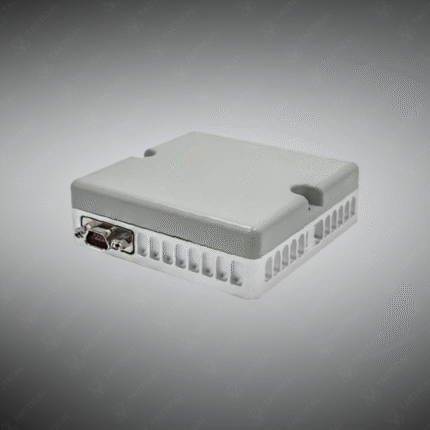
Design of a Compact High Isolation 4-Element Wideband
The Design of a Compact High Isolation 4-Element Wideband antenna array involves engineering a spatially efficient, multi-antenna system that operates over a broad frequency range while maintaining minimal mutual coupling (high isolation) between its four radiating elements. This design is critical for modern MIMO (Multiple-Input, Multiple-Output) and phased array applications in communications, radar, and electronic warfare, where close element spacing is needed for a small footprint, but high isolation is essential to preserve signal integrity, maximize channel capacity, and ensure independent beamforming or signal processing without interference.
Key Design Challenges & Solutions:
– Wideband Impedance Matching: Ensuring each antenna element maintains efficient radiation across a broad target bandwidth (e.g., 2-6 GHz).
– High Port-to-Port Isolation (>20 dB): Employing techniques like defected ground structures (DGS), neutralization lines, parasitic elements, or orthogonal polarization to reduce mutual coupling between closely spaced elements.
– Compact Footprint: Arranging four elements in a minimal area (e.g., a square or linear array) often using planar antenna types like microstrip patches, monopoles, or slot antennas.
– Stable Radiation Patterns: Maintaining consistent gain and radiation characteristics for each element across the operating band despite close proximity.
– Design Optimization: Utilizing electromagnetic simulation software (like CST, HFSS) to model and iteratively optimize geometry, substrate material (dielectric constant), and element spacing.
– Application-Specific Goals: Tailoring parameters for end-uses such as 5G base stations, UAV comms, portable SATCOM, or direction-finding systems.
Achieve superior multi-antenna performance in a small package. For advanced antenna design consultation and solutions, partner with the experts at Tactical Supply Pakistan.
Showing the single result