


Blog
Thermal Drone Detection in Pakistan: Spotting Tiny Drones

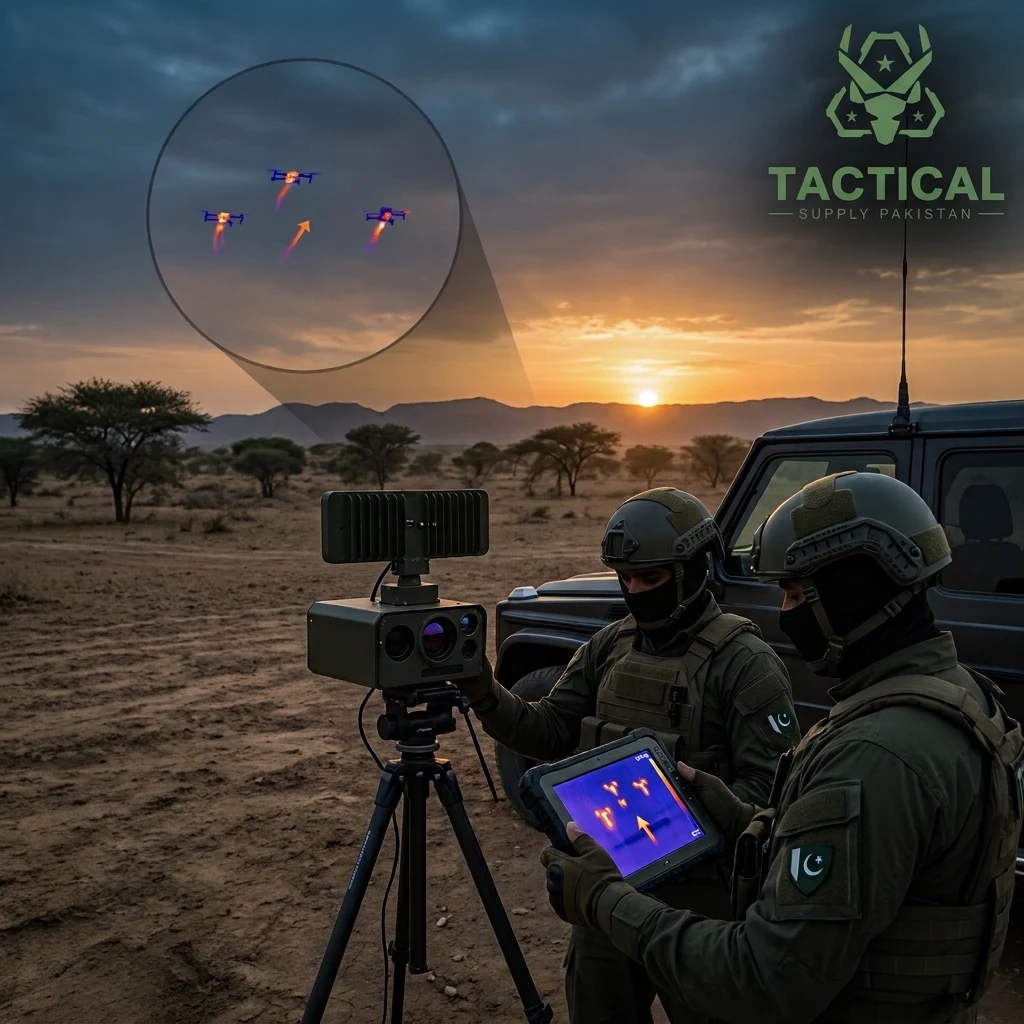
Picture a night guard at a power plant. The lights are on. The cameras are running. A tiny drone flies toward the fence. The guard cannot see it. A normal camera can barely see it either. This is why thermal drone detection in Pakistan is getting more attention. A thermal camera sees heat, not light. Add smart software, and it can spot small drones from far away.
This guide uses simple words. You will learn how it works. You will see some facts. You will also get a buyer’s checklist and answers to common questions.
What Is Thermal Drone Detection?
Thermal drone detection means finding drones by their heat. Drone motors and batteries get warm. A thermal imaging camera can see that warmth, even in the dark.
The camera is one part of a drone detection system. The system also has software. Many also add radar. Together, they warn a security team early.
Tactical Supply Pakistan supplies thermal and surveillance gear to defence, security, and disaster-management groups. For thermal drone detection, early warning is the main goal.
Why Are Small Drones Hard to Find?
Small drones are tricky for four reasons:
- They are small. Many fit in a backpack.
- They are quiet. From far away, you cannot hear them.
- They fly low. Trees and buildings can hide them.
- They look like birds. This causes false alarms.
Good perimeter security is not only about stopping a drone. It is about seeing it early. Every extra second gives your team more time to check, warn, and act.
What Does “Pixels on Target” Mean?
A camera picture is made of tiny dots. These dots are called pixels. A faraway object fills only a few dots.
Think of a person on a distant hill. Up close, you see a face. From far away, you see a tiny dot. “Pixels on target” counts how many dots an object fills. Fewer dots mean it is harder to find.
Here is a fact. In April 2026, Teledyne FLIR released software called Prism C-UAS. It can find small drones with fewer than four pixels on target (source). This shows a clear trend in thermal drone detection: smart software now matters as much as the camera.
Why Use Thermal Instead of Night Vision?
A normal camera needs light. Night vision boosts tiny amounts of light. A thermal camera reads heat instead. So thermal drone detection works in total darkness. It is also less bothered by glare from lamps and headlights.
But thermal is not magic. Small electric drones give off little heat. So results depend on the sensor, the lens, the distance, and the weather. That is where AI helps.
How Does AI Help?
AI software does three jobs:
- It finds. It scans the picture all day and spots tiny moving dots.
- It sorts. It helps tell a drone from a bird or a plane.
- It tracks. It follows the object so a guard can see where it goes.
AI does not replace the guard. It shows the guard where to look.
Why One Sensor Is Not Enough
No single tool sees everything. Experts say sensor fusion is the big idea of 2026. It means joining radar, thermal cameras, and other sensors into one picture (source).
Radar gives a wide early warning. A thermal imaging camera shows what the object is. Software ties the two together. This layered way is now common in counter-UAS work. (“Counter-UAS” means defence against drones.) For strong thermal drone detection in Pakistan, use layers, not one tool.
What Changes Detection Range?
Brochure numbers come from good test days. In real life, many things change the detection range:
- Sensor size: more pixels show more detail far away.
- Lens zoom: a longer lens brings far objects closer.
- Dust, haze, and heat shimmer: these are common in Pakistan and can cut thermal range.
- Target size and heat: a big, warm target is easier to see than a small, cool one.
- Clutter: hot ground and moving trees can hide a drone.
- Software: the same camera can perform very differently with different software.
Always ask what a range number means. Seeing a person, a car, and a small drone are three different jobs.
How Tactical Supply Pakistan Can Help
We offer thermal cameras, long-range surveillance cameras, infrared radar, and drone detection radar. Our range includes the Night Navigator series and a 2D infrared radar with 360° coverage. Our team helps you match the right gear to your site, your needs, and your budget. We can also help you plan layers that work together for thermal drone detection in Pakistan.
Need help choosing? Request a quote or ask for our catalogue.
Frequently Asked Questions
1. How far can the Night Navigator cameras see?
The Night Navigator series lists human detection ranges from 2.9 km to 19.0 km, depending on the model. The NN 3000 covers 2.9 to 6.3 km. The NN 4000 covers 4.2 to 9.5 km. The NN 8000 covers 6.3 to 19.0 km. These numbers are for people. A small drone is harder to see, so ask our team for drone detection range figures for your site.
2. What is a 2D infrared radar, and how fast does it lock on?
It is a 360° sensor that uses heat to find targets. Our 2D infrared radar locks on in under 4 seconds. Its angle accuracy is below 0.5 mrad, which means it can point very precisely. It has a 75 mm infrared thermal lens and weighs 30 kg.
3. Does thermal drone detection work in dust, fog, and at night?
It works at night because it reads heat, not light. Dust, fog, haze, and humidity can shorten the range, though. Ask for tests in conditions like yours. This matters for thermal drone detection in Pakistan, where heat and dust are common.
4. Do I need radar and a thermal camera, or just one?
Most sites do best with both. Radar finds things over a wide area. The thermal camera confirms what the object is. This is sensor fusion in action. One tool alone leaves gaps.
5. How do I get a quote, and who can buy?
Use our contact page or call 042-35763338. We serve defence, security, and disaster-management groups. Some products need licences or end-user papers. Our team will explain the steps for your order.