



Blog
Long-Range Thermal Imaging & Panoramic Surveillance Guide

Eyes in the Dark: The Role of Long-Range Thermal Imaging and Panoramic Surveillance in Modern Tactical Reconnaissance
Darkness used to be the great equalizer. A patrol could move under cover of night, a border crosser could time their approach for the small hours, and an observation post’s effective range shrank to whatever a searchlight could reach. That’s no longer true. On today’s borders, checkpoints, and forward positions, long-range thermal imaging and panoramic surveillance have replaced light with heat as the deciding factor — and understanding how they work is now essential knowledge for anyone responsible for reconnaissance, perimeter security, or border protection in Pakistan.
What Is Long-Range Thermal Imaging, and Why Does It Matter for Reconnaissance?
Long-range thermal imaging detects infrared radiation — heat — rather than visible light, converting the temperature difference between a person, vehicle, or object and its surroundings into a visible image. Because it doesn’t depend on ambient light at all, it works identically in total darkness, through smoke and light fog, and against most camouflage, which blocks visible light but not heat.
Just as important: thermal sensors are passive. They read radiation instead of emitting it, so the observer’s own position stays hidden — no IR illuminator beam, no light source to give the game away. That combination — sees everything, reveals nothing — is precisely why it’s become the backbone of modern reconnaissance rather than a specialist add-on.
Long-Range Thermal in the Operator’s Hands
The most immediate application sits at the individual and squad level, where the engineering challenge is specific: give the operator thermal capability without forcing them to abandon the day optic they’ve already trained and zeroed.
That’s the problem Tactical Supply Pakistan’s Thermal Imaging Clip-On (6000J) is built to solve. Rather than replacing the day scope, it mounts in front of it — the shooter keeps their zero, their familiar reticle, and their muscle memory, while gaining on-demand thermal vision. According to the product listing, it runs a 60Hz refresh rate for smooth tracking of moving targets, offers four selectable thermal palettes, delivers roughly three hours of runtime per charge, and is shock-rated to survive 6,000 joules of recoil — a genuinely demanding spec, since a clip-on that can’t handle repeated rifle recoil isn’t field gear, it’s a liability. It’s purpose-built for infantry marksmen, special operations units, and reconnaissance squads who need overwatch and night-patrol capability without re-zeroing every time conditions change.
Panoramic Surveillance: Closing the Blind Spots
A single thermal scope, however capable, still shows only a narrow slice of the horizon. Reconnaissance isn’t just about seeing far — it’s about ensuring nothing crosses undetected through the gap nobody was watching. Panoramic surveillance solves that by capturing wide, often 360-degree, coverage continuously, instead of relying on an operator to manually sweep a perimeter.
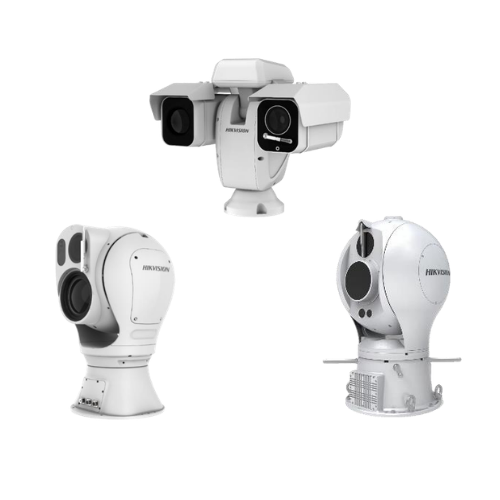
Tactical Supply Pakistan’s catalog reflects this with two complementary systems. The Panoramic Surveillance Infrared Camera is built for exactly this continuous wide-area role. Alongside it, the Night Navigator (NN 3000) is offered across six mission-specific configurations with 4x–18x zoom and human-detection ranges the listing places between roughly 2.9 and 6.3 kilometres, depending on model — stabilized for use on moving platforms including naval vessels, ground vehicles, and UAVs. One feature worth flagging for checkpoint and maritime-boundary use: an integrated non-lethal laser dazzler, which lets operators warn off an approaching threat before escalation becomes necessary.
For a border post, that’s the practical difference between “we can see a long way in the direction we’re pointed” and “nothing gets past this perimeter unseen.”
Thermal Imaging on the Move: Vehicle-Mounted Systems
Static posts aren’t the whole picture — mobile patrols and convoys need the same capability while in motion, and moving platforms are far harder on optics: vibration, dust, extreme temperature swings, and inconsistent power all take a toll.
The vehicle-mounted thermal cameras in Tactical Supply Pakistan’s range are specced for exactly that punishment: 360-degree pan capability, dual-spectrum imaging blending thermal with visible light, AI-assisted detection that flags pedestrians and vehicles automatically, IP69K-rated housings for dust and high-pressure water exposure, and wide voltage tolerance (roughly 12V–32V DC) so units run directly off standard tactical vehicle electrical systems without a dedicated power solution.
The Perimeter Now Includes the Sky
Ground-level surveillance used to be the whole job. It isn’t anymore — low-cost drones are now a common reconnaissance and harassment tool, which means modern perimeter security has to look up, not just out.
Two systems in the catalog address this directly. The 2D Phased Array and Infrared Detection Solution Radar pairs phased-array radar with electro-optic/infrared tracking for continuous 360-degree aerial coverage — the listing cites drone detection out to roughly 2.5 kilometres even against very small radar signatures, plus vehicle identification out to about 4 kilometres, built for air-defense units and critical infrastructure protection. Alongside it, the Wearable Drone Detector gives an individual patrol member self-contained detection capability that doesn’t depend on a fixed base station — useful precisely because forward operatives are often the first to encounter a drone, not the last.
Why This Matters for Pakistan’s Security Landscape
Pakistan’s security forces operate across an unusually demanding range of terrain within a single country: high-altitude positions along the LoC, where cold favors sharp thermal contrast; desert stretches, where heat haze and dust degrade ordinary optical cameras; dense urban centers; and a long coastline demanding genuine maritime stand-off range. A system tuned for one environment often struggles in another.
This is the real value Tactical Supply Pakistan brings to the table. Rather than offering a single generic thermal camera, the company has built a genuinely mission-matched catalog — clip-on scopes for marksmen, panoramic systems for fixed posts, ruggedized vehicle-mounted units for mobile patrols, and radar-assisted systems for aerial threats — backed by free installation support and ongoing maintenance commitments rather than a one-time sale. For defense, law enforcement, and critical-infrastructure teams across Pakistan, that combination of field-tested equipment and after-sales accountability is what separates a genuine reconnaissance partner from a simple equipment vendor.
Choosing the Right System for the Mission
A few things are worth checking against any spec sheet before you buy:
- Detection vs. recognition vs. identification range — a camera that can detect something at 6km often can’t tell you what it is until much closer. These are different numbers; don’t read them interchangeably.
- Sensor resolution and thermal sensitivity (NETD) — lower NETD resolves finer heat differences, which matters most in humid or high-ambient-temperature conditions.
- Refresh rate — 60Hz tracks a moving target far better than 30Hz, whether for a marksman or a drone-tracking radar.
- Ruggedization — IP rating and shock resistance decide whether a unit survives vehicle mounting and field deployment, not just bench testing.
- Power compatibility — a vehicle-mounted unit needing a power source it wasn’t given is dead weight.
- Coverage type — narrow long-range zoom and wide panoramic sweep solve different problems; most posts need both, not one instead of the other.
Frequently Asked Questions
What is long-range thermal imaging and how does it work in tactical reconnaissance?
Long-range thermal imaging detects infrared heat radiated by people, vehicles, and objects rather than visible light, converting temperature contrast into an image. It works in total darkness, through smoke, and against most camouflage, making it a core tool for reconnaissance, border patrol, and perimeter security.
What’s the difference between thermal imaging and night vision?
Night vision amplifies existing ambient light — moonlight, starlight — so it fails in total darkness or heavy fog. Thermal imaging detects heat instead of light, so it works identically regardless of ambient light and sees through smoke, fog, and camouflage that defeat night vision.
How far can panoramic surveillance cameras detect a human or vehicle?
Detection range varies by model, sensor, and conditions, but systems like Tactical Supply Pakistan’s Night Navigator (NN 3000) list human-detection ranges from roughly 2.9 to 6.3 kilometres depending on configuration. Actual range depends on target size, atmospheric conditions, and terrain.
Can a thermal imaging clip-on scope be used with any day scope?
Most clip-on thermal units, including the Thermal Imaging Clip-On (6000J), are designed to mount in front of an existing day scope using adjustable mounts, preserving the shooter’s zero and reticle without requiring a scope swap or re-zeroing.
Why is 360-degree panoramic surveillance important for border security?
A single fixed-angle camera leaves gaps an intruder can route around. Panoramic surveillance captures the full perimeter continuously, removing manual sweep gaps and giving operators a persistent, complete picture of everything approaching a post or checkpoint.
Are these surveillance systems suitable for vehicle-mounted or mobile patrol use?
Yes. Tactical Supply Pakistan’s vehicle-mounted thermal cameras are built for mobile use specifically — rated IP69K for dust and water resistance, compatible with standard 12V–32V vehicle power systems, and equipped with AI-assisted detection for patrol and convoy operations.
