



Blog
Long Sword Laser Defense System

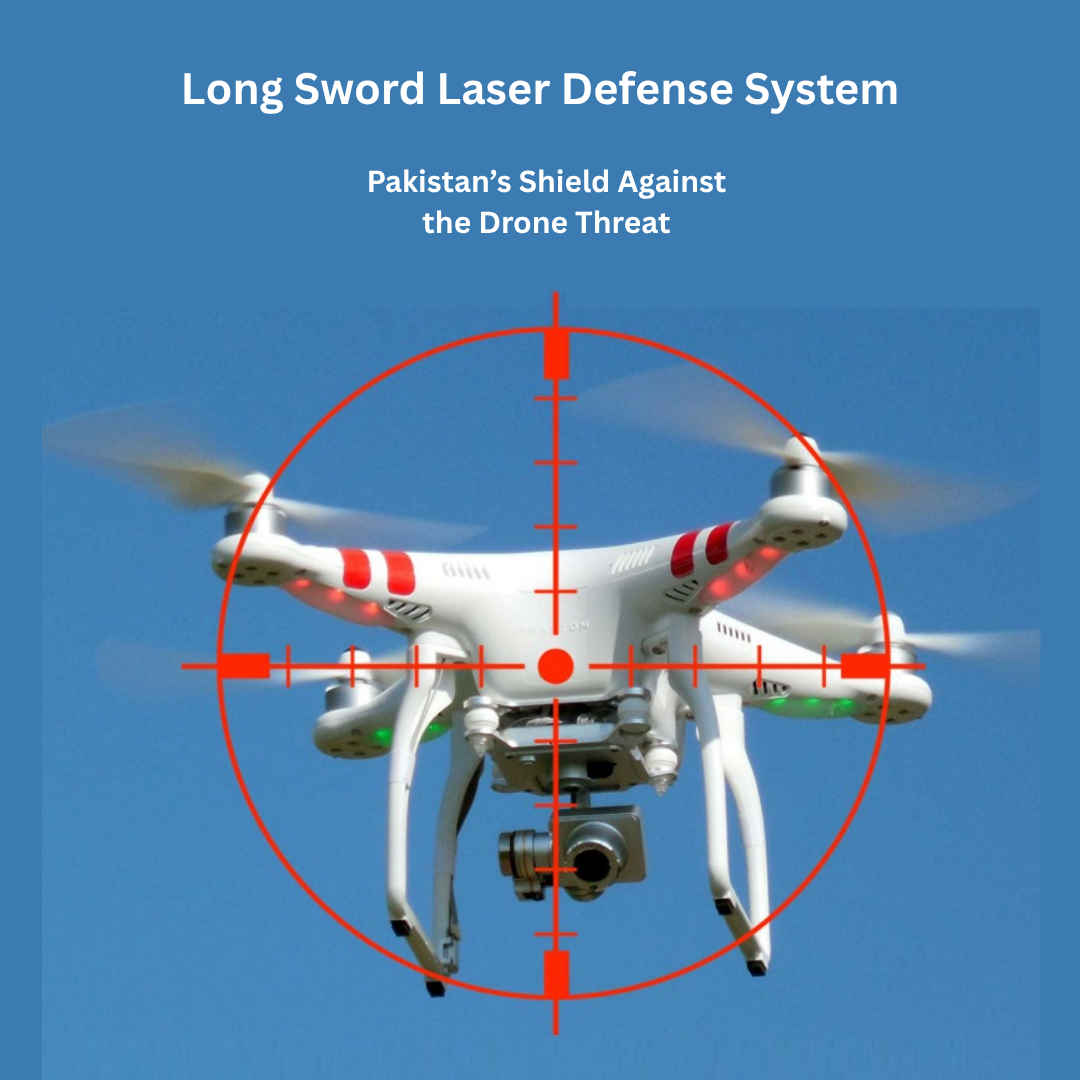
Pakistan’s Shield Against the Drone Threat
The battlefield is changing — and it is changing fast. Unmanned aerial vehicles (UAVs), once reserved for high-budget military operations, are now commercially available tools that can be weaponized by state and non-state actors alike. For a country like Pakistan, where critical infrastructure, borders, VIP convoys, and nuclear installations demand round-the-clock protection, the need for a fast, cost-effective, and reliable counter-drone solution has never been more urgent.
Enter the Long Sword Laser Defense System — a state-of-the-art directed-energy weapon platform distributed in Pakistan by Tactical Supply Pakistan. Designed to neutralize low-altitude, slow-speed, and small-size (LSS) aerial threats, the Long Sword system represents a new era in Pakistan’s domestic and perimeter defense capabilities.
What Is the Long Sword Laser Defense System?
The Long Sword Laser Defense System is a high-powered, ground-based laser platform engineered specifically to detect, track, and destroy LSS aircraft — the category of threat most commonly posed by commercially available drones, quadcopters, and reconnaissance UAVs. The system comes in two primary variants, each tailored to different operational environments and mission profiles: the Long Sword-X (fixed defense) and the Long Sword-Q (mobile defense).
What sets the Long Sword apart from conventional anti-drone methods — jammers, nets, or kinetic interceptors — is its use of a precisely focused laser beam to physically destroy the target. This eliminates the need for expensive ammunition, reduces collateral damage risk, and allows near-instantaneous engagement once the target is confirmed.
A cost-effective answer to an asymmetric threat — each engagement costs a fraction of a conventional interceptor missile.
Long Sword-X: Fixed-Site Laser Defense
The Long Sword-X is engineered for permanent installation at high-value, fixed locations. Its role is to provide an invisible but lethal perimeter that deters, detects, and defeats drone-borne threats before they can photograph, surveil, smuggle contraband into, or attack a protected facility.
| LONG SWORD-X — TECHNICAL SPECIFICATIONS | |
| Laser Power | 3 kW – 4 kW |
| Maximum Attack Distance | 1.0 km – 1.2 km |
| Maximum Attack Time | 120s / Battery or Continuous Urban Power |
| Pitch Angle | -20° to +60° |
| Azimuth Angle | ±170° |
| Standard Detection Distance | 2 km (RCS ≥ 0.01 m²) |
| Standard Attack Distance | 1.0 km |
The Long Sword-X is particularly well suited for airports, governor residences, nuclear power plants, oil depots, and dams — locations where a drone intrusion could trigger catastrophic consequences. Its wide azimuth coverage of ±170° and a pitch angle range from -20° to +60° means virtually no approach vector is left unguarded. The system operates on continuous urban power, meaning it can maintain an always-on defensive posture with zero downtime.
Long Sword-Q: Mobile Laser Defense
Where the Long Sword-X excels at static defense, the Long Sword-Q is built for the battlefield and the motorcade. Mounted on an armored tactical vehicle, the Q variant delivers rapid-mobility, self-defense, and attack capability — even while in motion. This makes it invaluable for VIP convoys, army camps, border patrol operations, and field training environments.
| LONG SWORD-Q — TECHNICAL SPECIFICATIONS | |
| Laser Power | 3 kW – 10 kW |
| Maximum Attack Distance | 1.0 km – 2.0 km |
| Maximum Attack Time | 120s / Battery Power |
| Pitch Angle | -15° to +70° |
| Azimuth Angle | N × 360° (continuous rotation) |
The Long Sword-Q’s full 360° continuous azimuth rotation is a standout feature — it means the vehicle-mounted system faces no blind spots whatsoever. With laser output scaling up to 10 kW, it can engage more hardened or faster-moving targets at a range stretching out to 2 kilometers. The Q variant can detect targets during movement, making it one of the few platforms globally capable of on-the-move laser engagement.
All-Weather, All-Environment Operational Capability
A defense system is only as good as its reliability under real-world conditions. The Long Sword system has been engineered to operate in Pakistan’s diverse and often harsh environments — from the icy mountain passes of the north to the scorching desert plains of Balochistan and Sindh.
Key environmental ratings include:
- Extreme weather tolerance: snow, sandstorms, mold, thunder, and lightning
- Working temperature range: -20°C to +50°C
- Storage temperature range: -20°C to +55°C
- Altitude capability: up to 3,000 meters above sea level
- Protection rating: IP65 (dust-tight and water jet resistant)
- Solar irradiance tolerance: 1,120 W/m² for at least 4 hours
- Wind resistance: Level 5 and above
The system also handles complex electromagnetic and illumination conditions typical of urban environments, meaning it can be deployed in city centers or near airports without interference from surrounding infrastructure.
The 7-Step Engagement Workflow
One of the most sophisticated aspects of the Long Sword system is its clearly defined, multi-layered engagement workflow — ensuring precision, minimizing false positives, and keeping human operators in command at every critical decision point.
| 1 Radar Search | 2 Photoelectric Detection | 3 Target Recognition | 4 Tracking & Aiming | 5 Attack Judgment | 6 Attacking | 7 Confirming |
The sequence begins with radar search to identify any LSS aircraft entering the controlled airspace. Once a radar signature is detected, photoelectric sensors corroborate the finding and localize the target. Optoelectronic systems then confirm whether the object is a genuine threat before the system moves to tracking and aiming. Only after attack judgment — requiring either automated approval or human authorization — does the system fire. Post-engagement, attack confirmation is logged and the system restores to standby duty status automatically.
This layered decision tree makes the Long Sword suitable for deployment in environments where civilian aircraft or birds might otherwise trigger false engagements — a critical safety feature near airports or urban zones.
Application Scenarios: Where Long Sword Protects Pakistan
The versatility of the Long Sword system means it has a clear and pressing use case across nearly every sector of Pakistan’s security architecture:
| Head of Governor | International Airports | Dams & Water Infrastructure |
| Oil Depots | Nuclear Power Plants | Military Objectives |
| Border Defense | VIP Security | Army Camps |
Each of these environments carries unique threat profiles. An airport faces the risk of drone collisions with aircraft on approach. A nuclear power plant cannot afford a surveillance drone mapping its layout. An oil depot is catastrophically vulnerable to drone-mounted incendiary devices. The Long Sword is designed to provide layered, adaptive protection for all of them — seamlessly transitioning between battery power and fixed urban power sources depending on deployment context.
Operational Simplicity: One Person, Total Control
Advanced capability does not have to mean operational complexity. The Long Sword system has been engineered with user-friendliness as a core design principle. The system can be operated by a single individual, making it efficient for resource-constrained deployments. It features a quick power-on self-test, meaning it is combat-ready in minutes rather than hours.
The operational architecture is built around four interconnected modes:
- Automatic Alarm — perimeter monitoring without constant human attention
- Solo Operation — single-operator control for direct engagement
- Instruction Control — command-center directed engagement for larger deployments
- Real-time Feedback via Linkage System — full network integration for coordinated defense
This allows units to choose the level of automation that fits their operational context — from fully supervised manual control during VIP events to semi-automated perimeter defense at remote installations. Maintenance requirements are intentionally kept minimal, and the system’s durability is built for sustained field deployment without frequent servicing.
Why the Long Sword Matters for Pakistan’s Defense Strategy
Pakistan’s security landscape is defined by asymmetric threats. Cross-border drone incursions, non-state actors equipped with commercially available UAVs, and surveillance operations targeting critical infrastructure are no longer hypothetical scenarios — they are documented realities. Traditional air defense systems are not designed for this threat category; they are too slow, too expensive per engagement, and too complex to deploy at the dozens of locations that require protection.
The Long Sword Laser Defense System fills this gap with surgical precision. Its scalable laser power — from 3 kW for light drones to 10 kW for heavier targets — means one platform can handle the full spectrum of LSS threats. Its cost-per-engagement is a fraction of missile-based interceptors. And its ability to operate continuously without ammunition resupply makes it a logistically favorable option for both the Pakistan Armed Forces and civilian security agencies.
Tactical Supply Pakistan is proud to be the authorized distributor of this system, providing Pakistani defense establishments, law enforcement agencies, and security planners access to a world-class directed-energy solution.
Conclusion
The Long Sword Laser Defense System — available in the fixed Long Sword-X and mobile Long Sword-Q variants — represents a decisive technological leap in Pakistan’s ability to counter the growing UAV threat. With impressive range, adaptive laser power, all-weather resilience, and a rigorous multi-step engagement protocol, it delivers the precision and reliability that Pakistan’s most critical sites demand.
Whether guarding the gates of a nuclear facility, escorting a VIP motorcade through urban terrain, or defending a forward operating base along a contested border, the Long Sword is the definitive answer to the drone challenge of the modern age.
